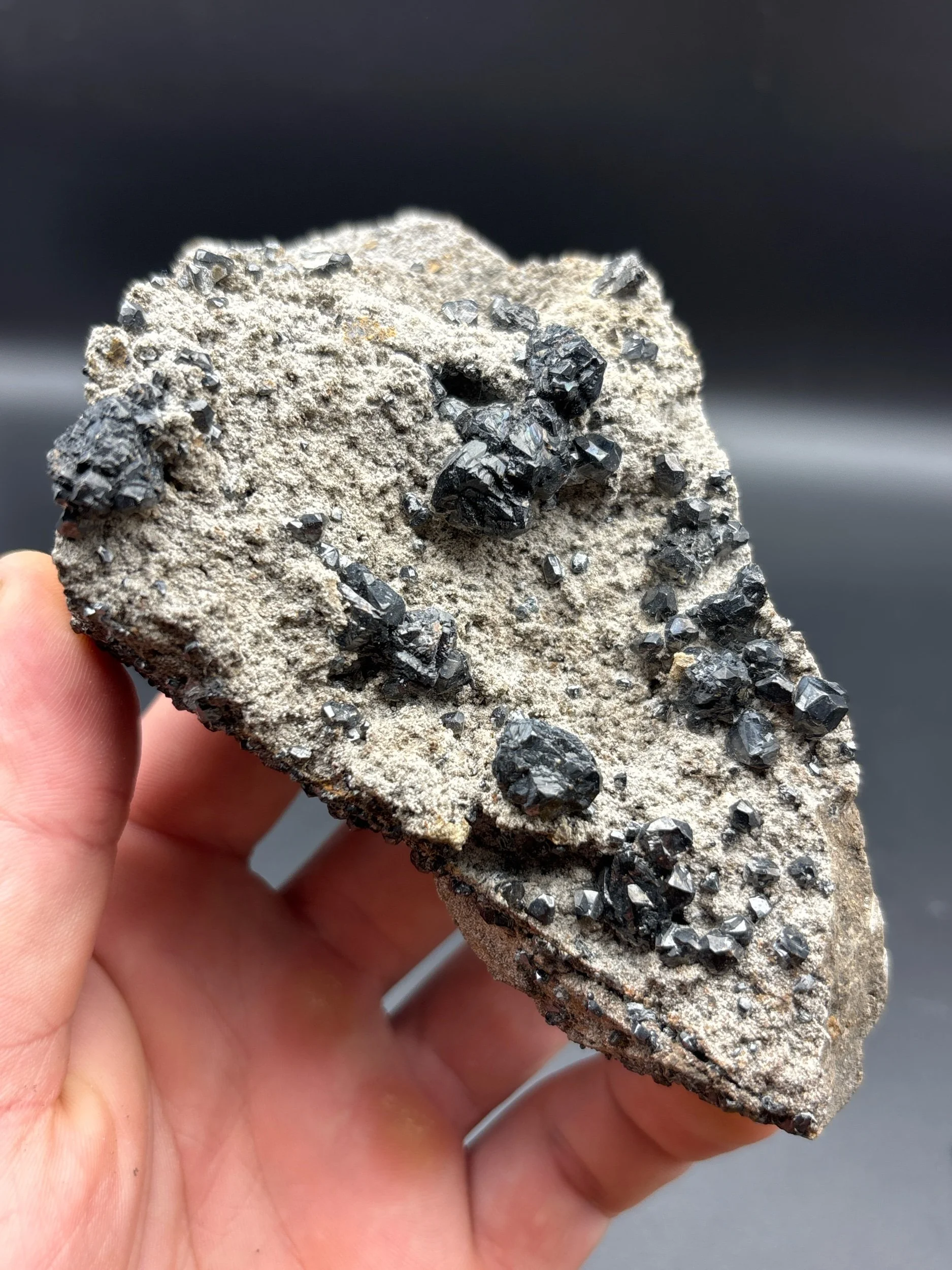
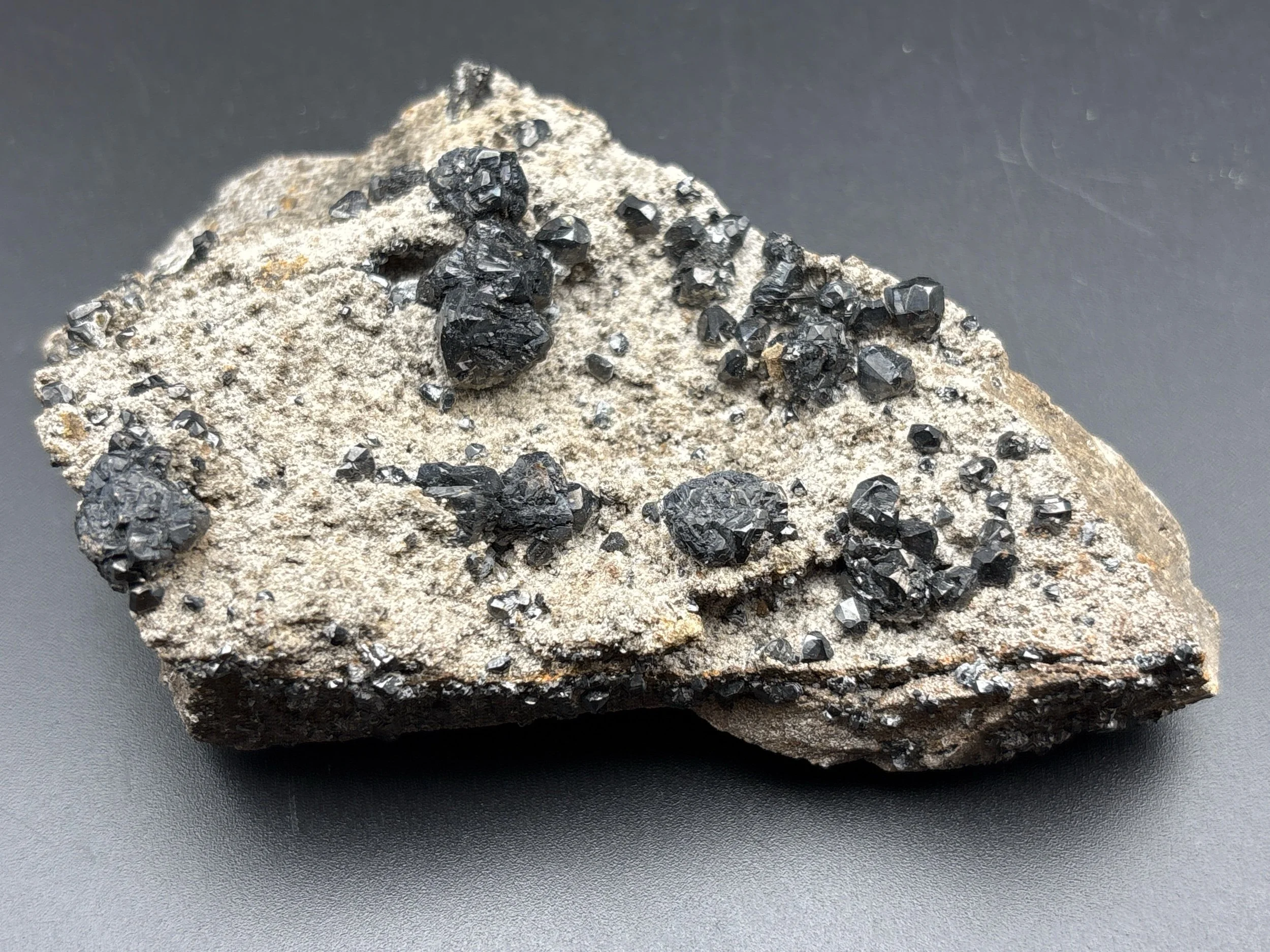
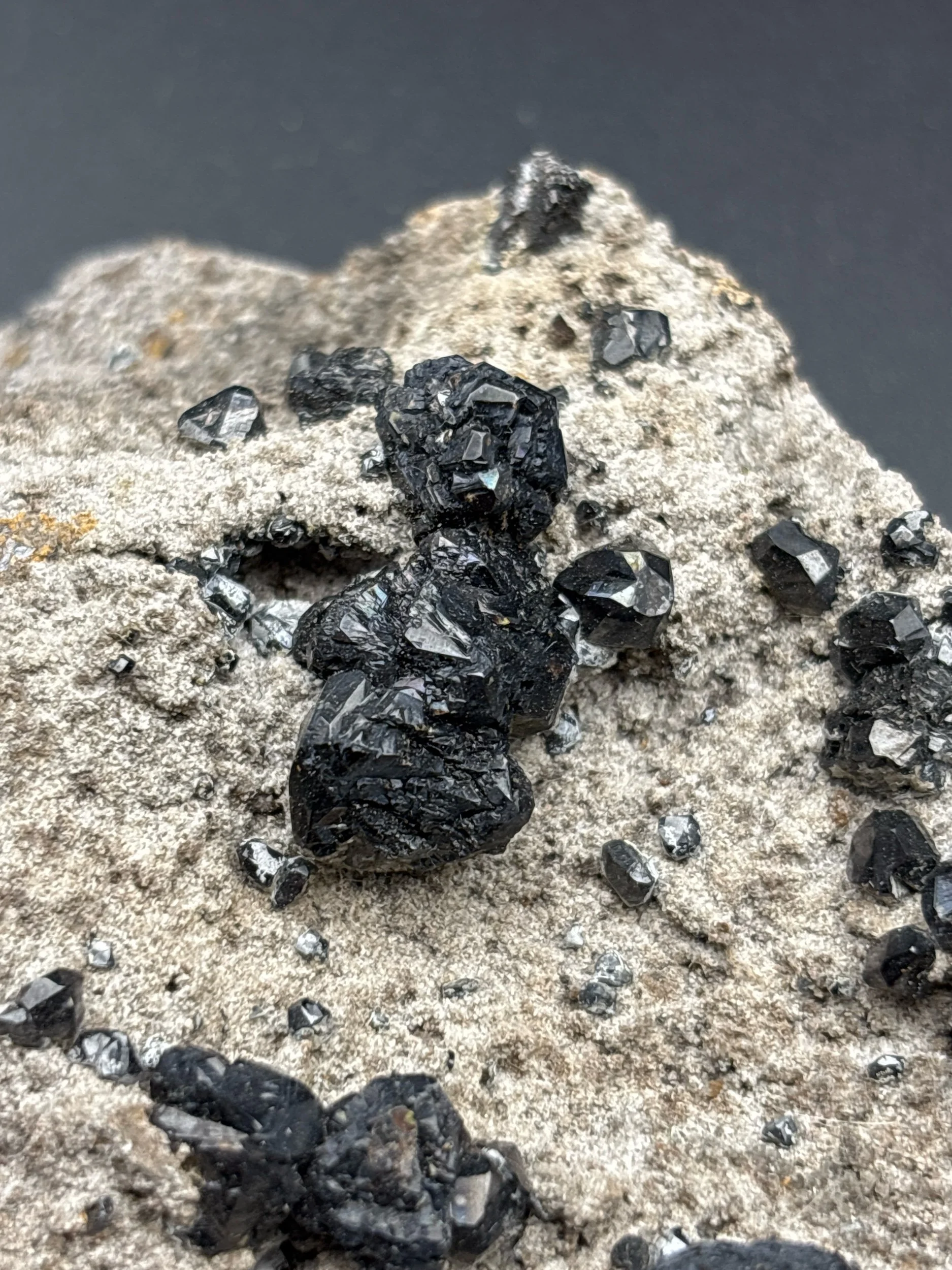
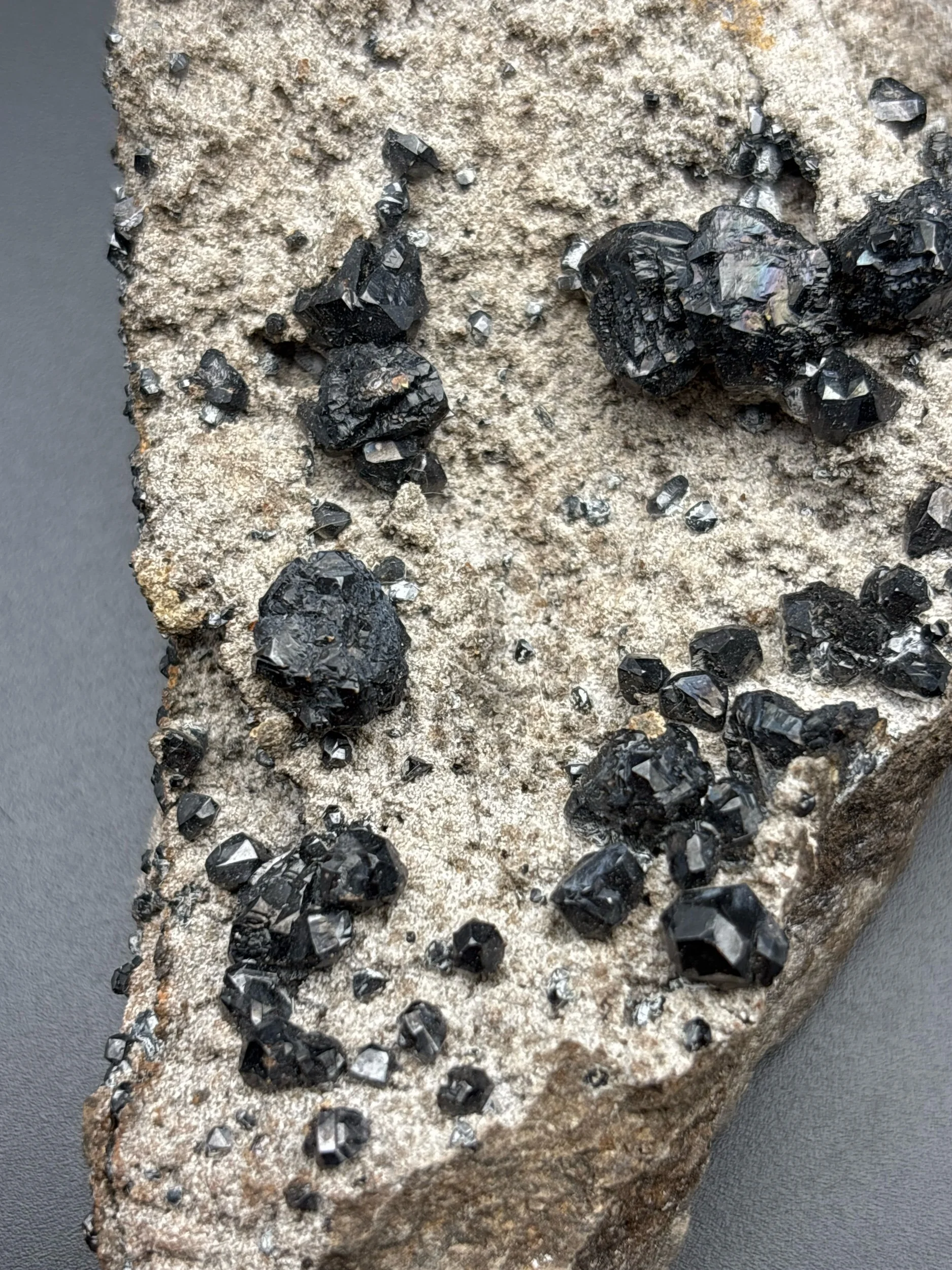
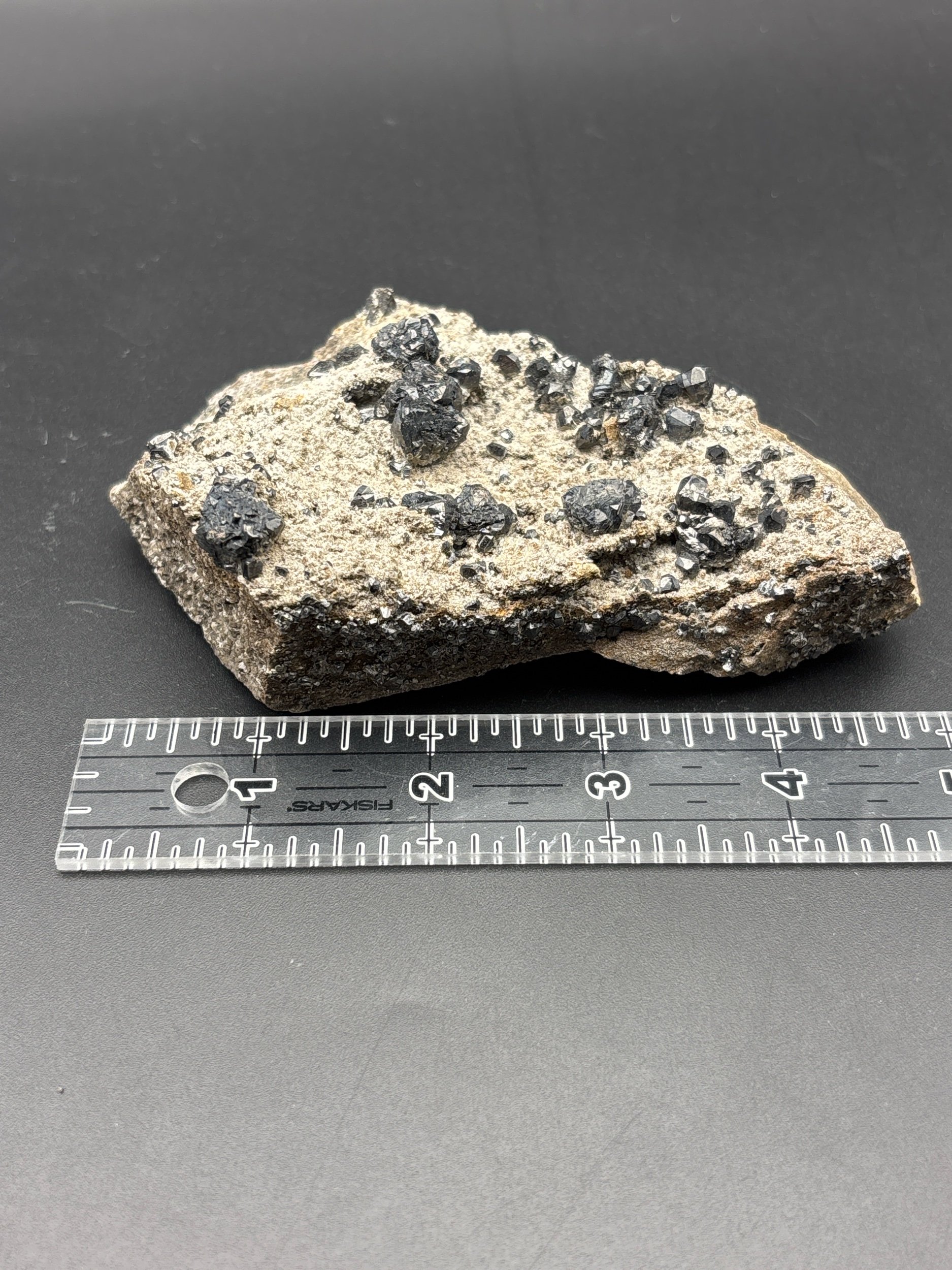
The Smallcleugh Mine appears to have been established around 1770, although significant development did not begin until later in the eighteenth century. Mining eventually extended along several mineralized veins and into stratabound replacement bodies known as flats, with the Handsome Mea and Smallcleugh veins associated with some of the earliest workings, including deposits reportedly discovered in 1776. The operation expanded more substantially after about 1787 and continued developing additional veins and flats until mining ceased in the early twentieth century; a further attempt to identify remaining ore reserves was made unsuccessfully in 1963. Among the mine's better-known historical episodes was a Masonic Lodge dinner held underground in the Ballroom Flats in 1901, while recreational exploration by amateur mine explorers appears to have begun by the late 1960s. Specimens of sphalerite, galena, calcite, and ankerite are desired by collectors.
This specimen is a matrix of classic Smallcleugh sphalerite. Formerly of the Scalisi collection, the complex and isolated crystal adorning this matrix present fine quality. A must have for sphalerite or classic European collectors!
Thank you so much for viewing! Please message for any further information
(5.1 × 3.0 × 1.5 in - 12.9 × 7.6 × 3.8 cm) 11.8oz / 336g
ORDERS SHIP MONDAYS
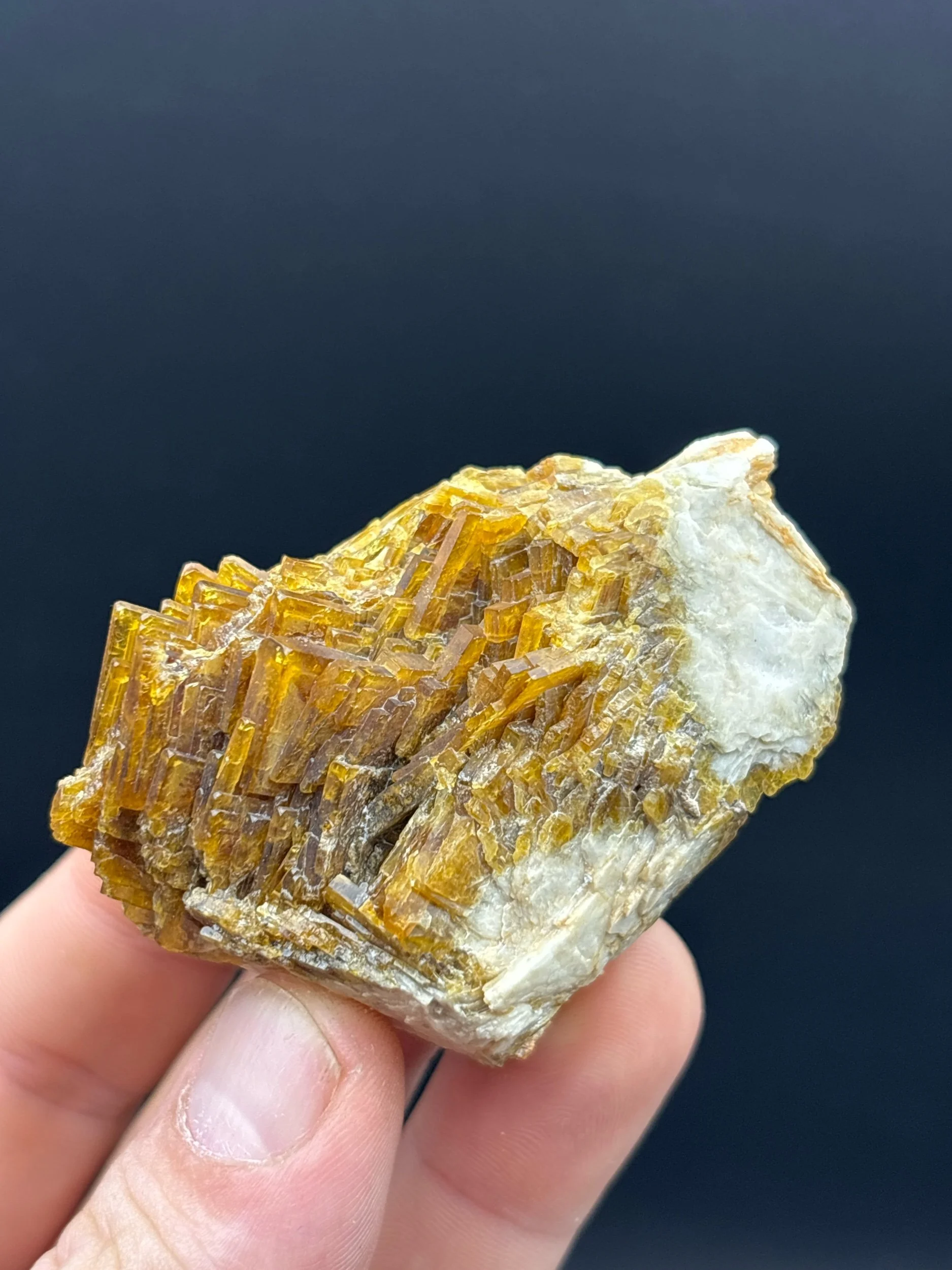
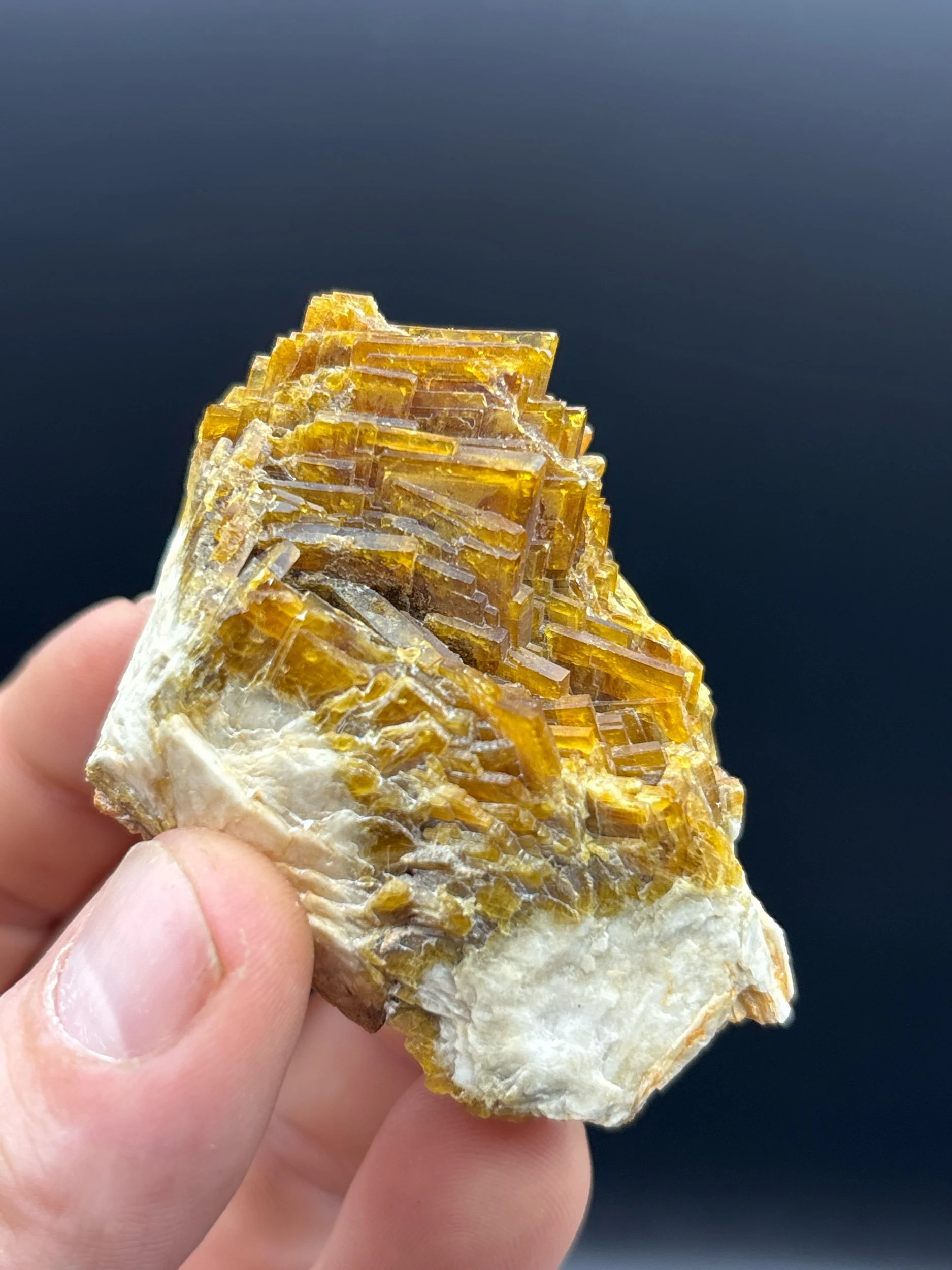
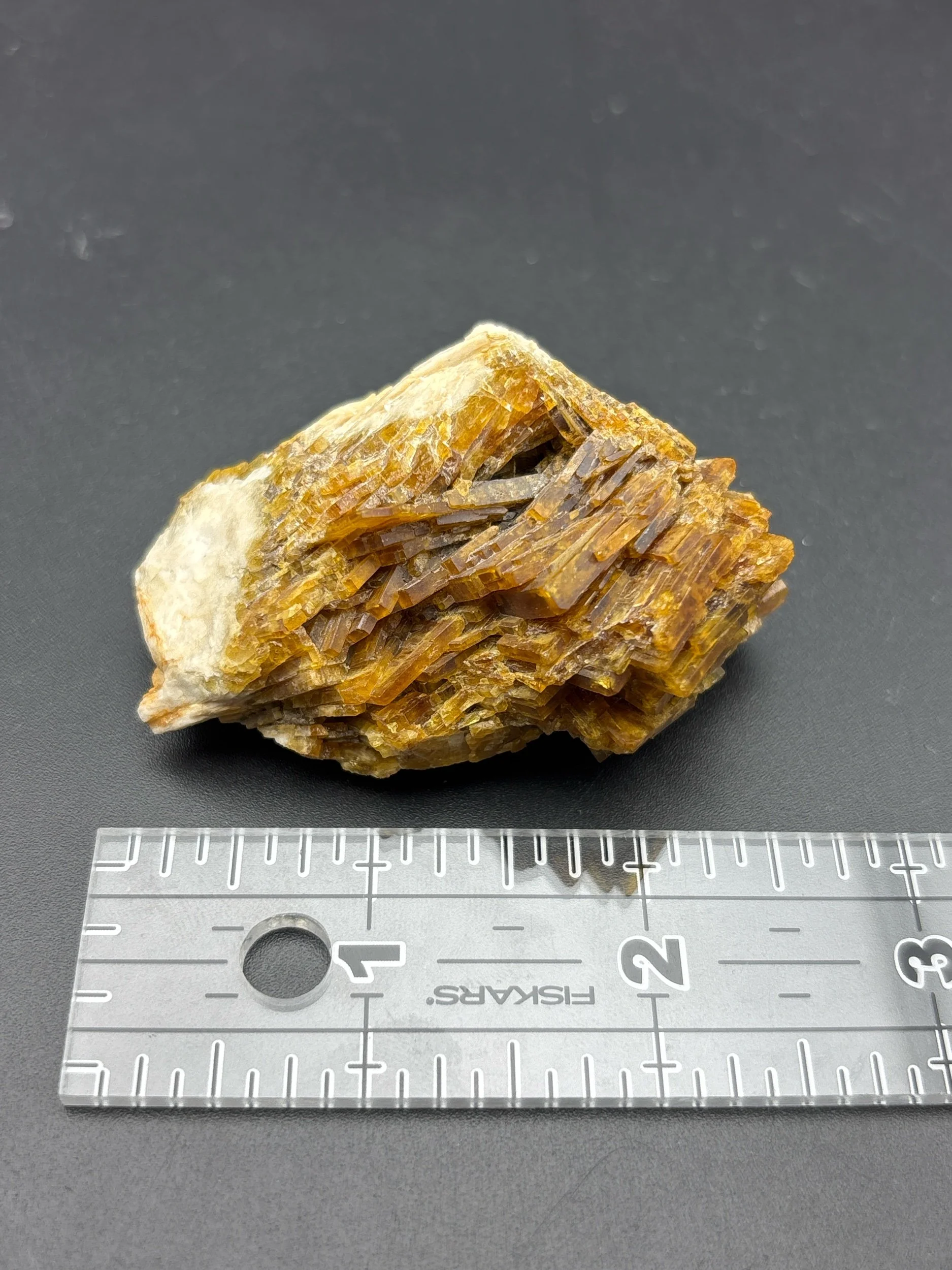
Mineral specimens from the Pack Rat Mine in Montana became known primarily through small-scale collecting rather than large commercial production. Early miners occasionally saved attractive pieces of crystallized minerals encountered while following the ore veins, and some of these specimens later entered private collections. Interest from mineral collectors increased during the mid-twentieth century as reports of well-formed crystals and unusual mineral associations circulated among hobbyists and dealers. Because the workings were relatively small, most specimens recovered from the mine were limited in number and often obtained directly from underground pockets or from material on nearby dumps. A portion of the better examples gradually found their way into mineral shows, museum collections, and the hands of regional collectors. Today, specimens attributed to the Pack Rat Mine are considered relatively uncommon and are usually associated with material recovered during earlier periods of mining and collecting. While the mine is actively held as claim, no known current specimen production exists.
This specimen is a classic cluster of baryte crystals. Rich honey brown color.
Thank you so much for viewing! Please message for any further information
(2.5 × 1.5 × 1.7 in - 6.3 × 3.8 × 4.3 cm) 4.7oz / 134g
Orders ship Mondays
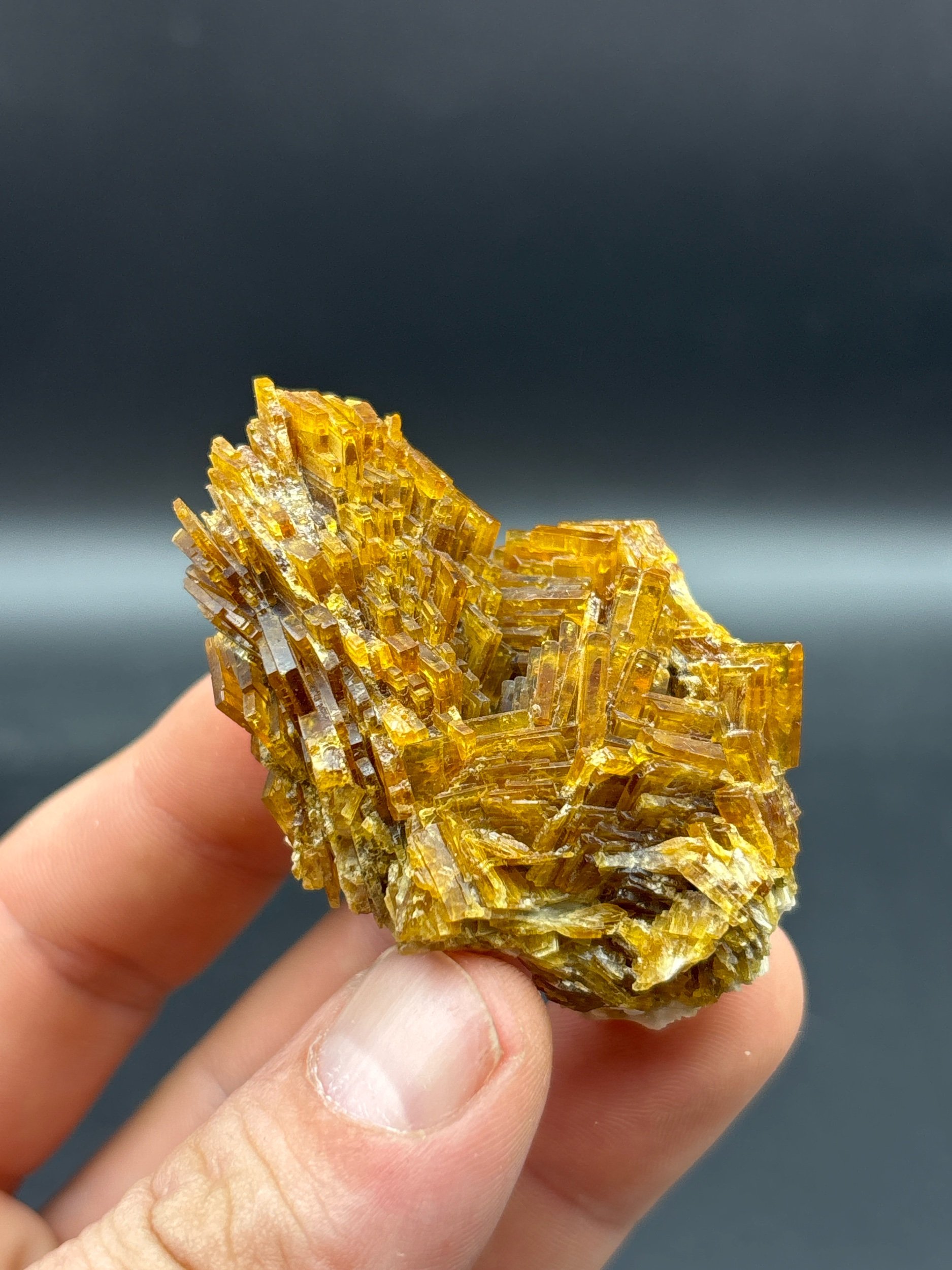
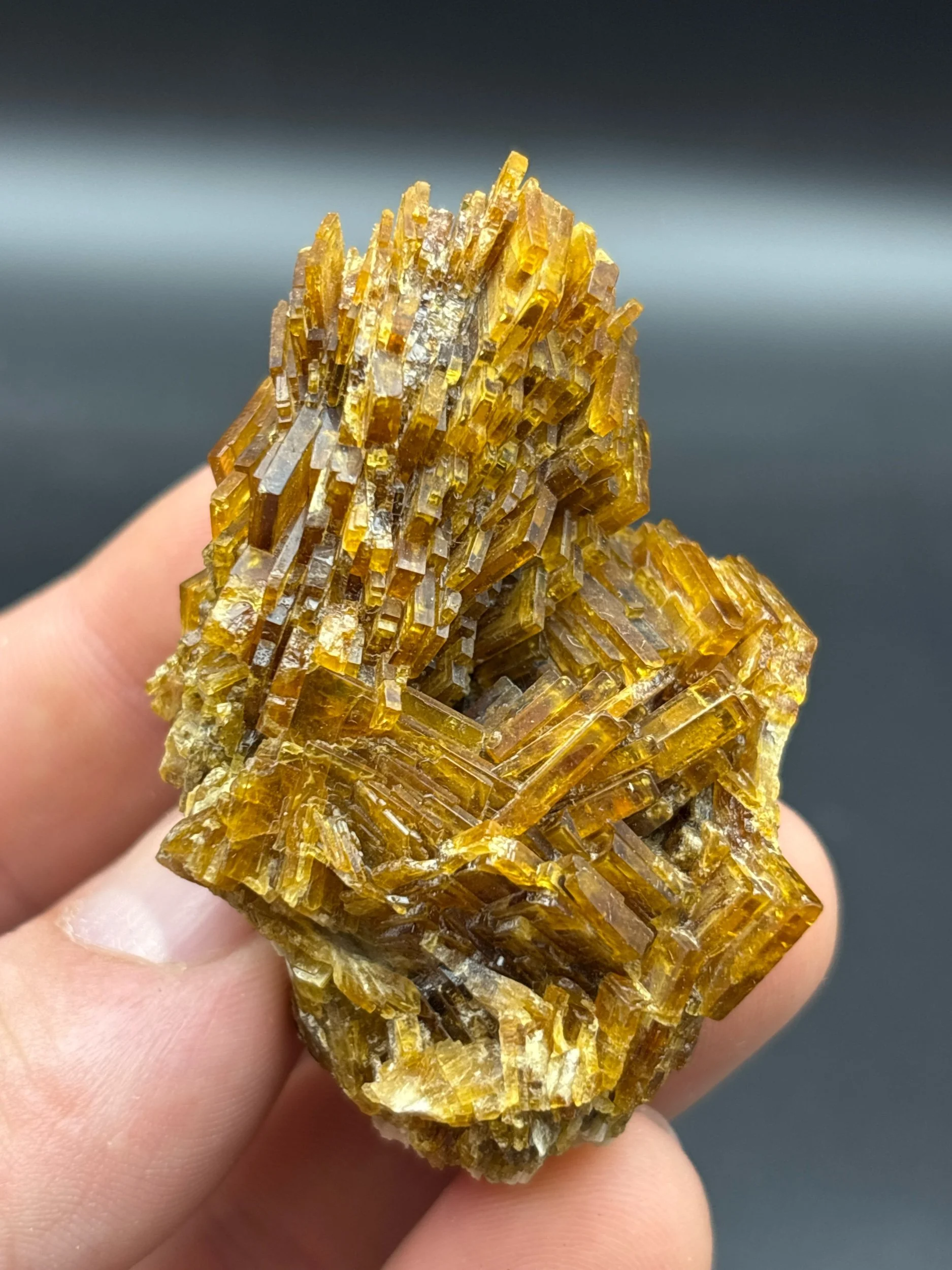
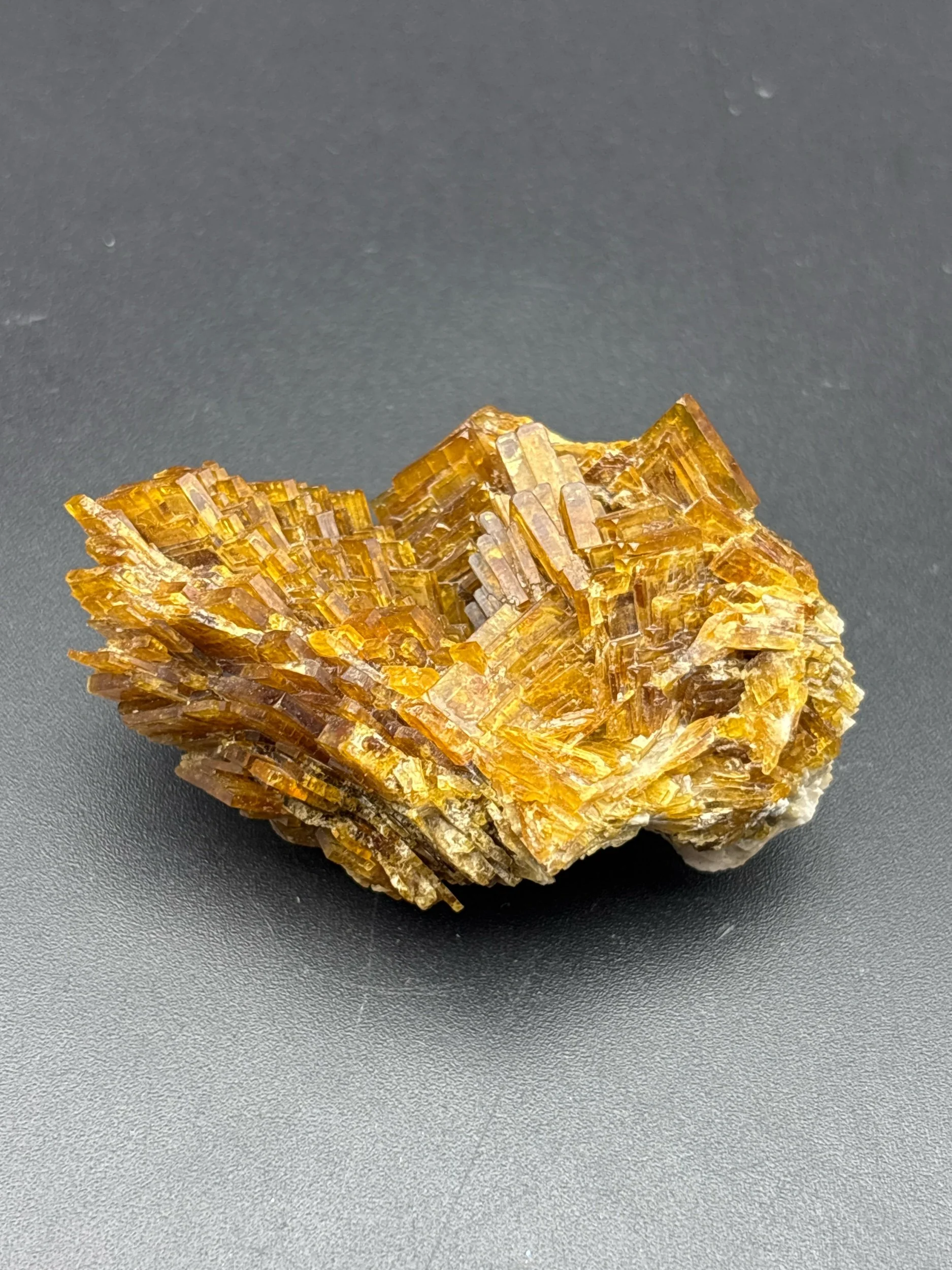
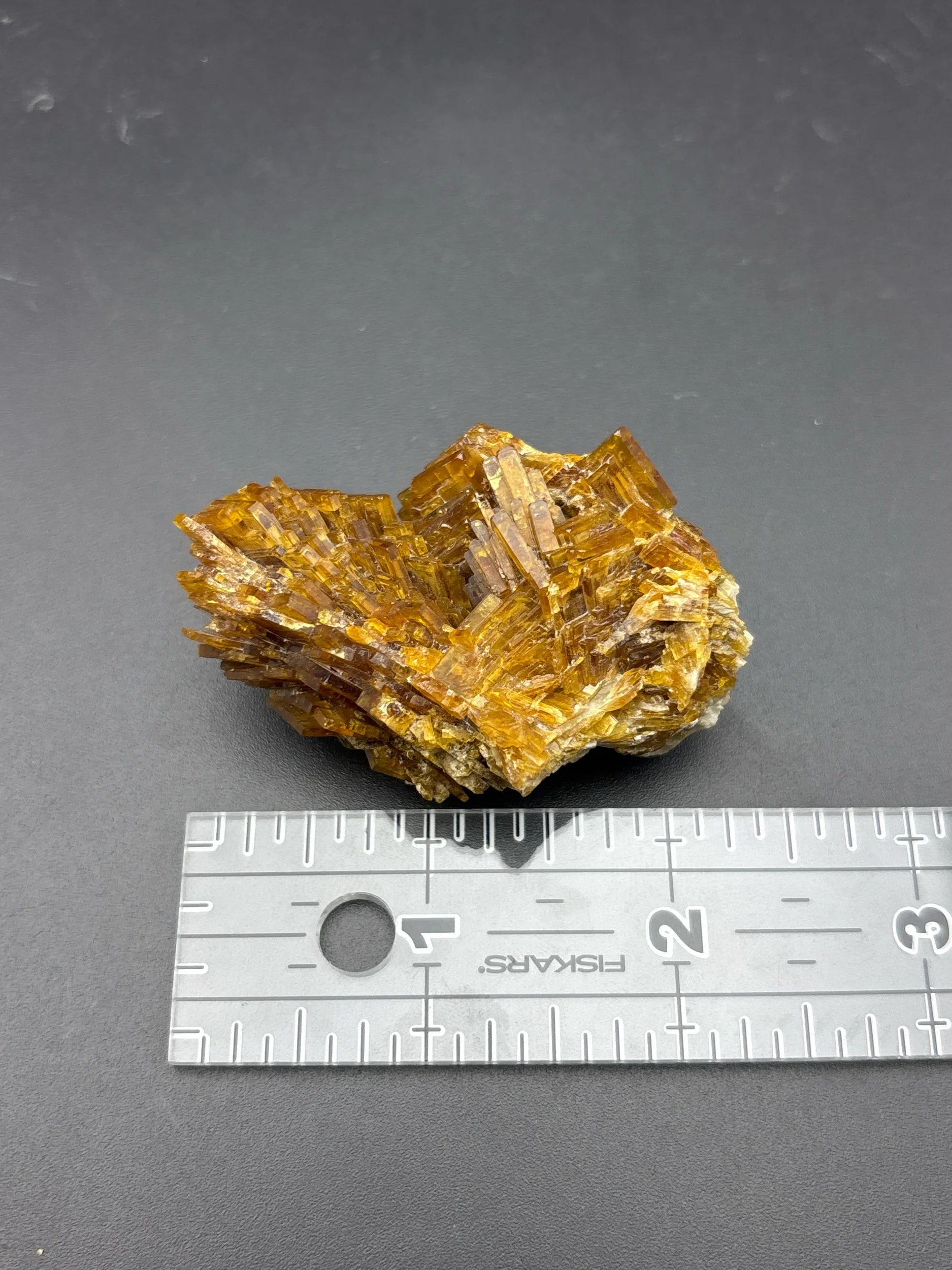
Mineral specimens from the Pack Rat Mine in Montana became known primarily through small-scale collecting rather than large commercial production. Early miners occasionally saved attractive pieces of crystallized minerals encountered while following the ore veins, and some of these specimens later entered private collections. Interest from mineral collectors increased during the mid-twentieth century as reports of well-formed crystals and unusual mineral associations circulated among hobbyists and dealers. Because the workings were relatively small, most specimens recovered from the mine were limited in number and often obtained directly from underground pockets or from material on nearby dumps. A portion of the better examples gradually found their way into mineral shows, museum collections, and the hands of regional collectors. Today, specimens attributed to the Pack Rat Mine are considered relatively uncommon and are usually associated with material recovered during earlier periods of mining and collecting. While the mine is actively held as claim, no known current specimen production exists.
This specimen is a classic cluster of baryte crystals. Overall visual appeal is great. Rich honey brown color.
Thank you so much for viewing! Please message for any further information
(2.3 × 1.5 × 1.2 in - 5.8 × 3.8 × 3.0 cm) 2.8oz / 79g
Orders ship Mondays
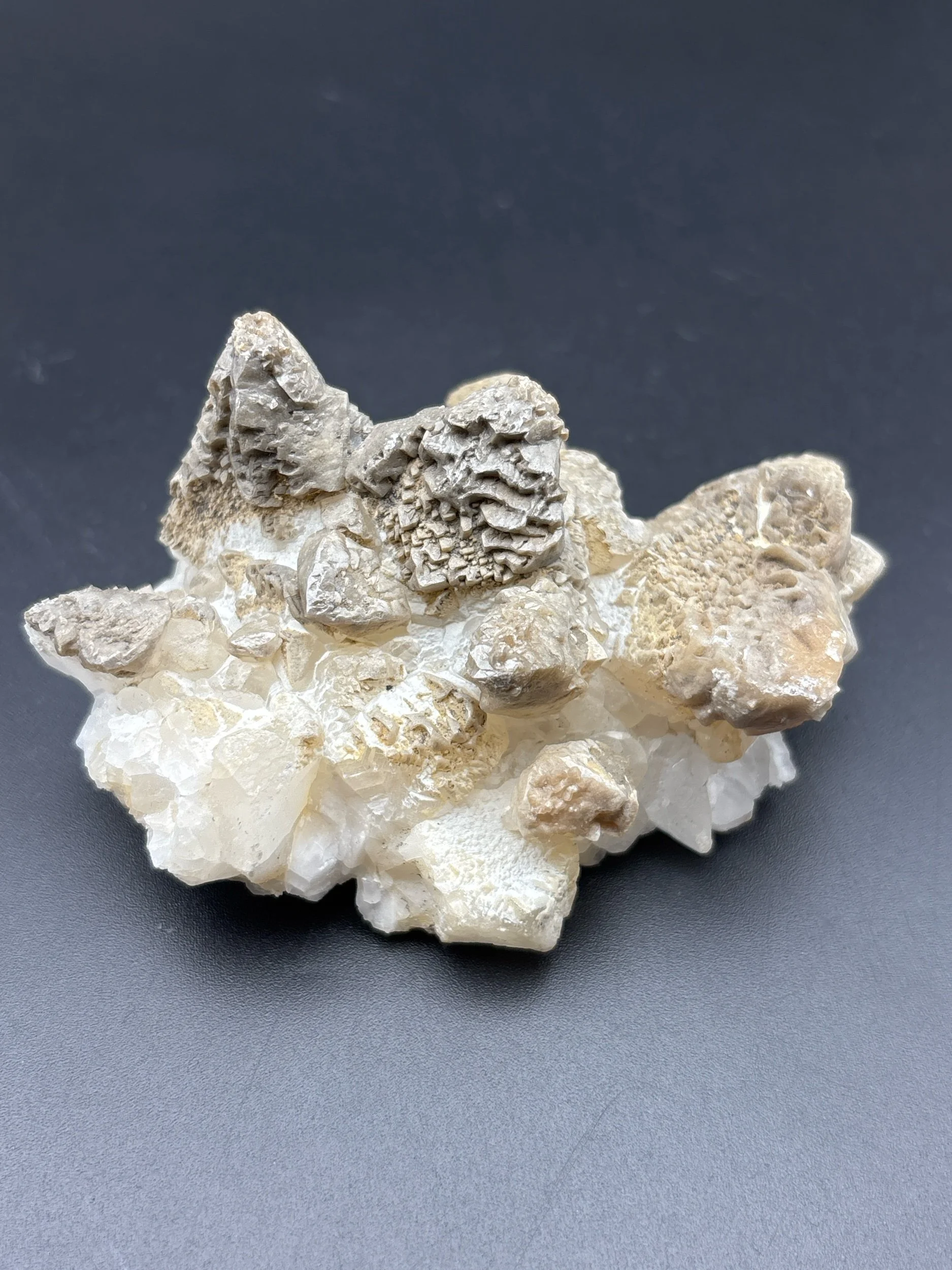
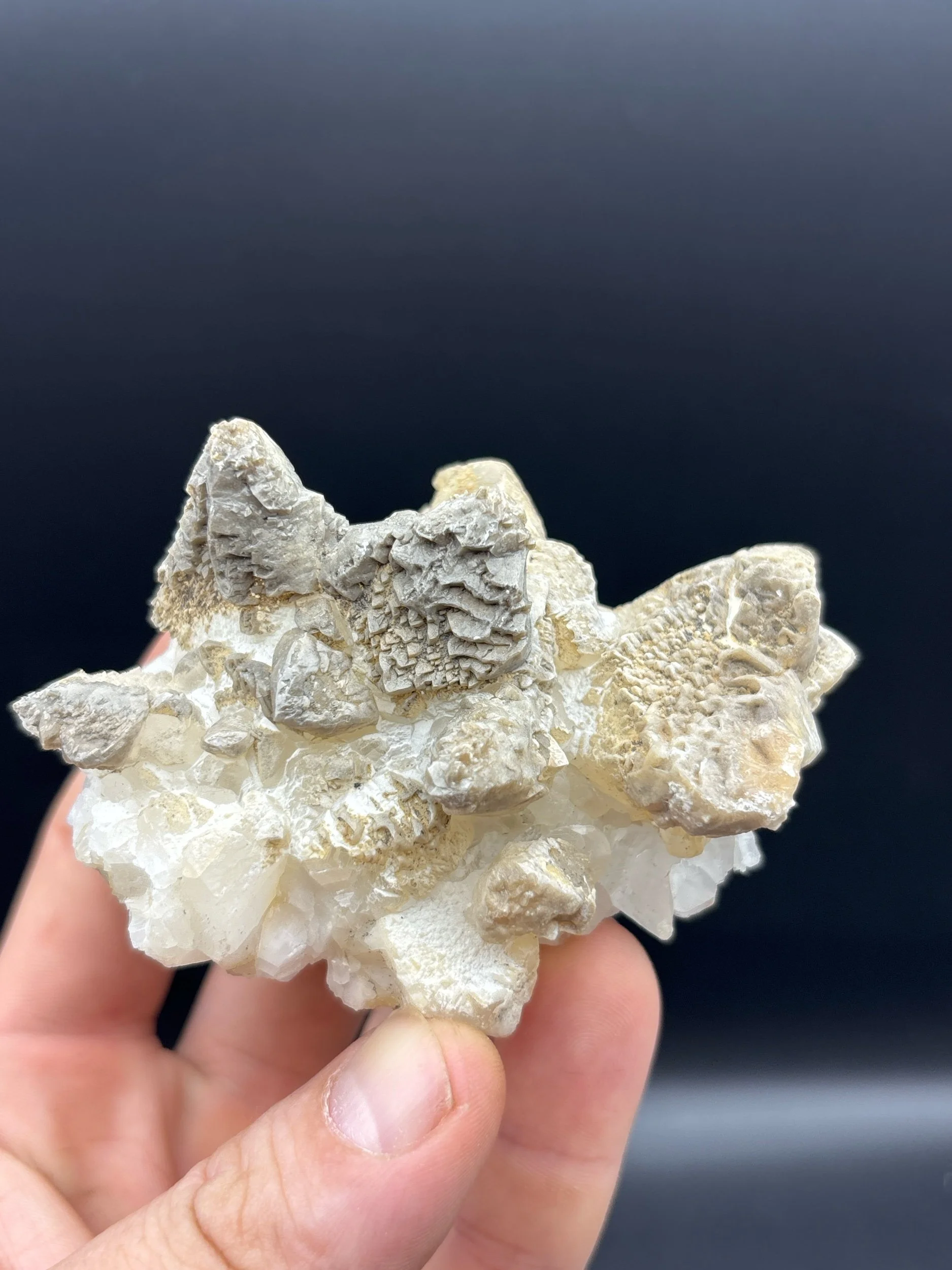
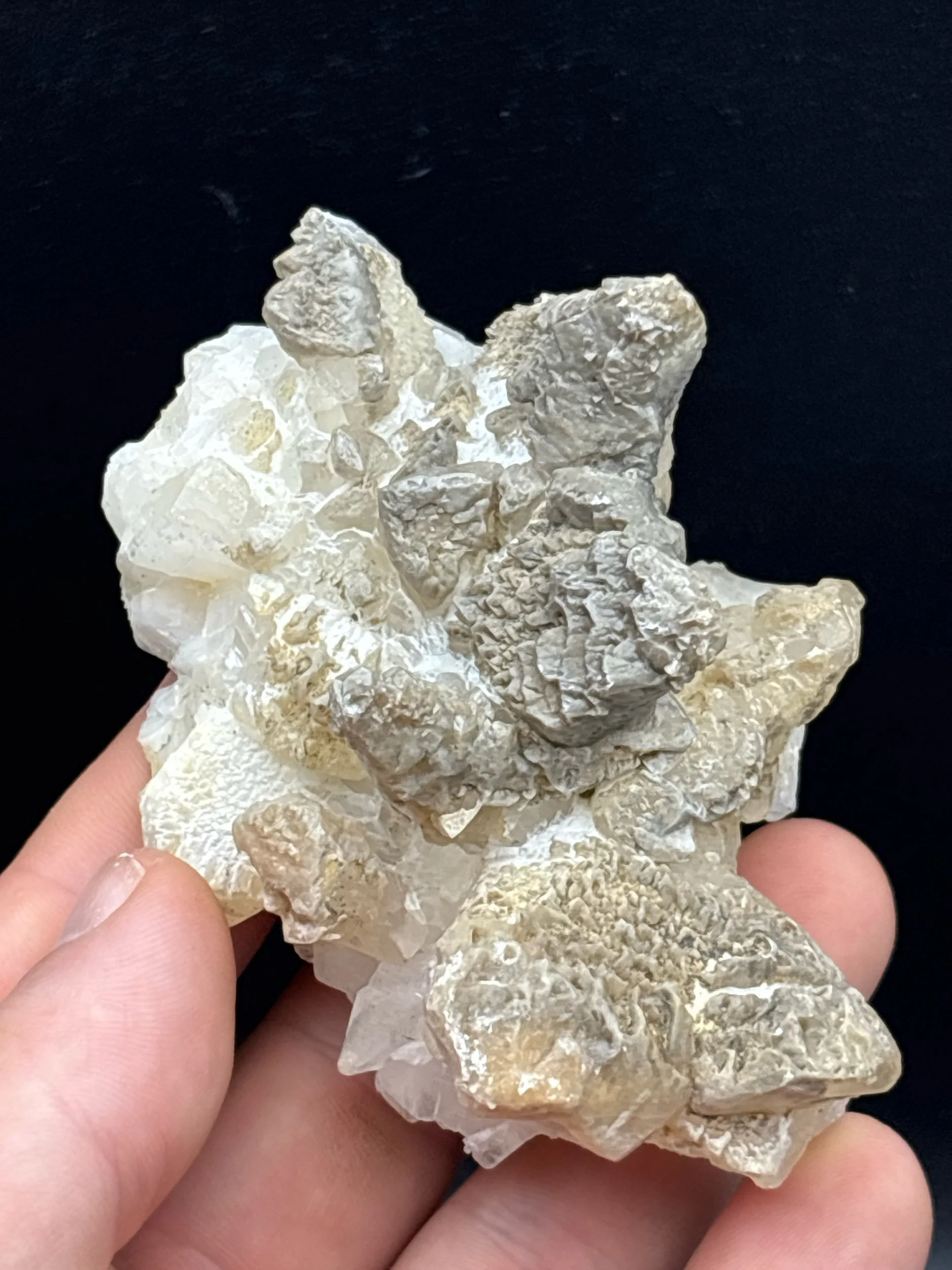
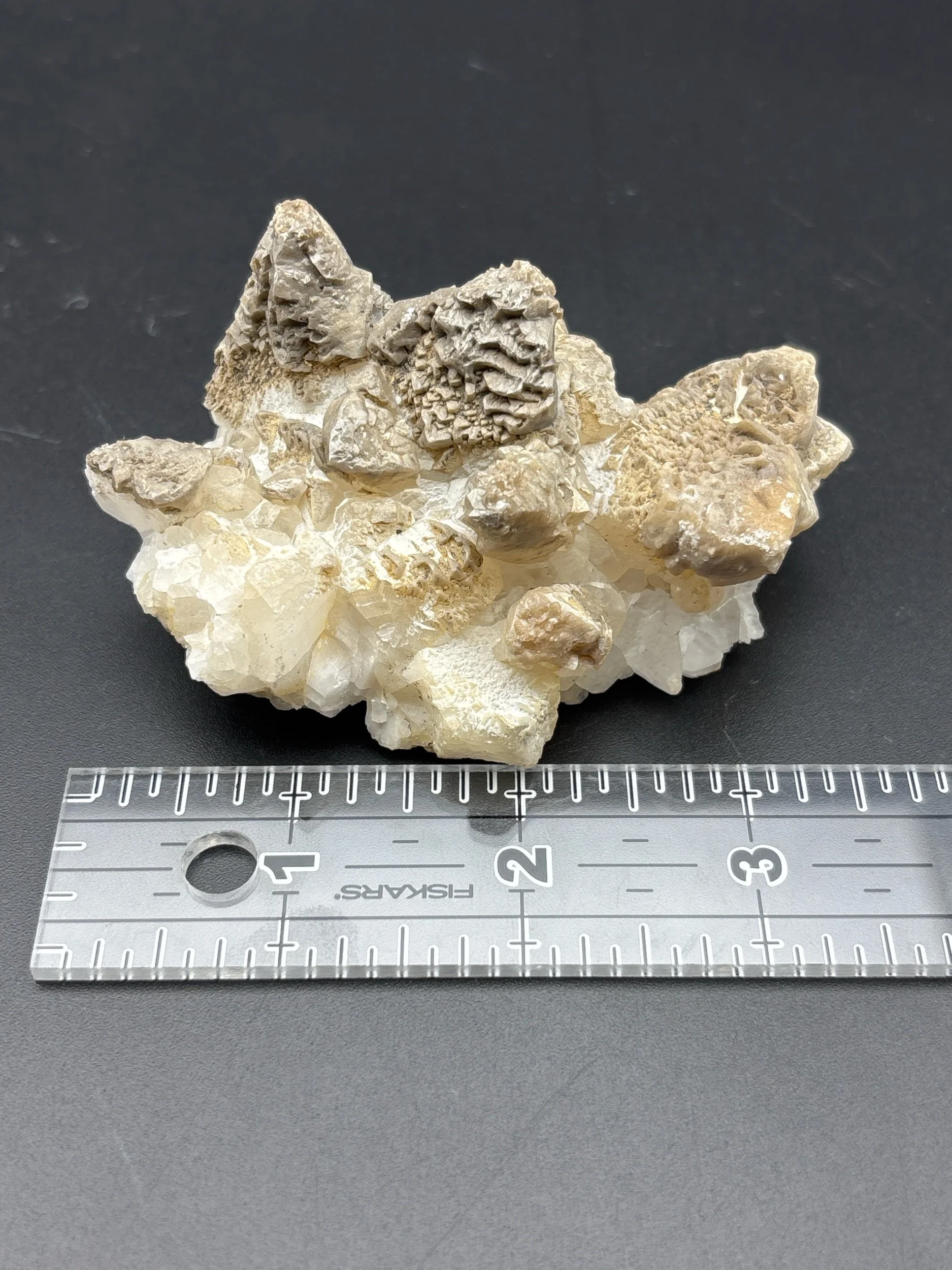
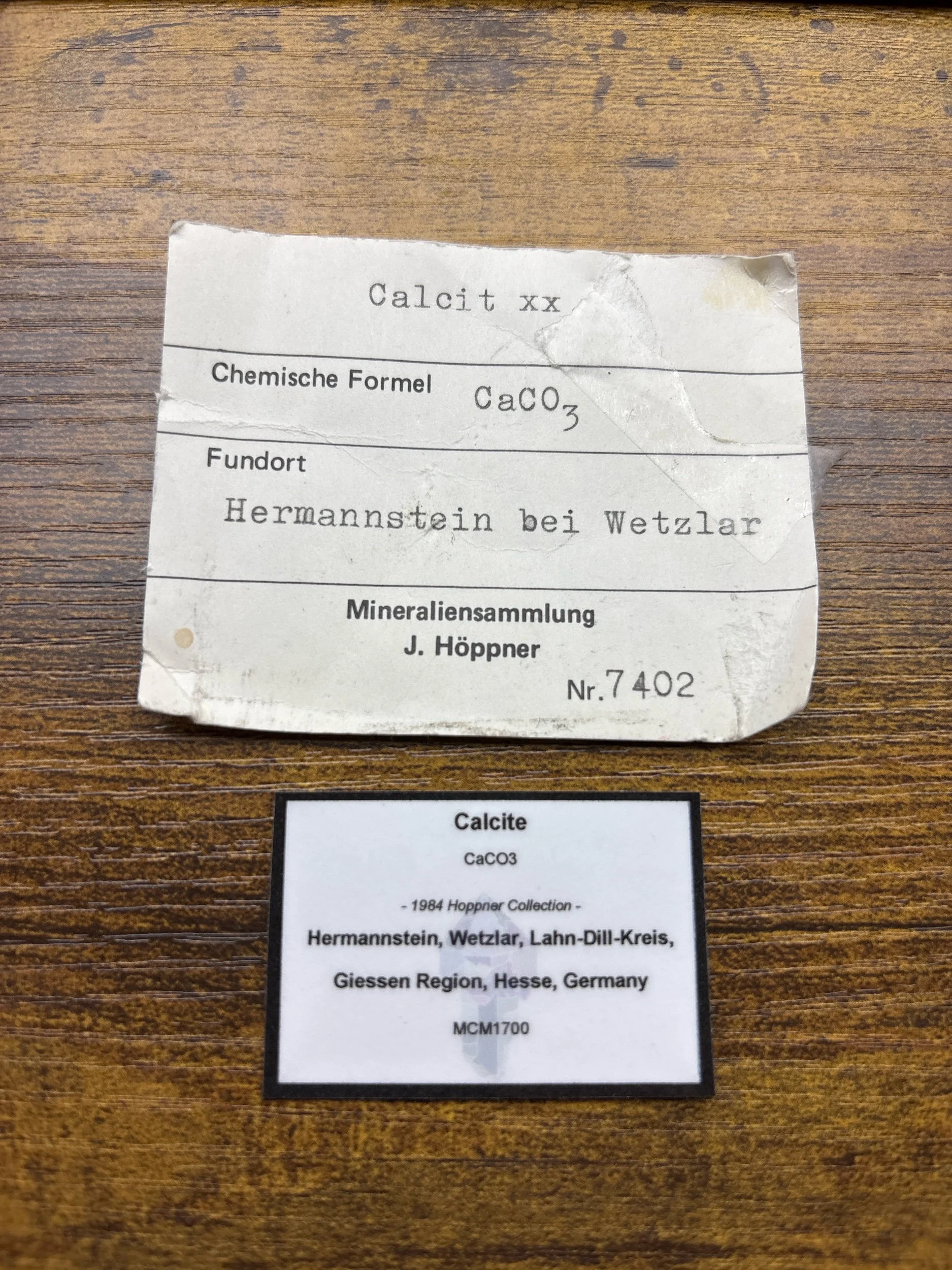
Crystal collecting at Hermannstein, near Wetzlar in Hesse, is closely associated with the historic workings and quarries of Simberg, where extraction of limestone and manganese ores exposed mineralized cavities and alteration zones. The former Malapertus Mine, an ancient manganese operation abandoned in 1931, produced manganite, pyrolusite, and psilomelane, while the adjoining limestone quarry has yielded calcite, dolomite, quartz, nontronite, and manganese oxides. Although Hermannstein was not primarily a commercial source of gemstones, quarrying and mining provided opportunities for recovery of crystallized material, particularly quartz and calcite, from fractures and cavities within the limestone.
This specimen is a bed of lustrous calcite crystals with a very unique character in texture. Towards the terminations, the overgrowths become lustrous and complex. From the JHoppner Collection, dated April 1984.
Thank you so much for viewing! Please message for any further information
(3.5 × 2.5 × 1.8 in - 8.8 × 6.3 × 4.5 cm) 6.1oz / 173g
ORDERS SHIP MONDAYS
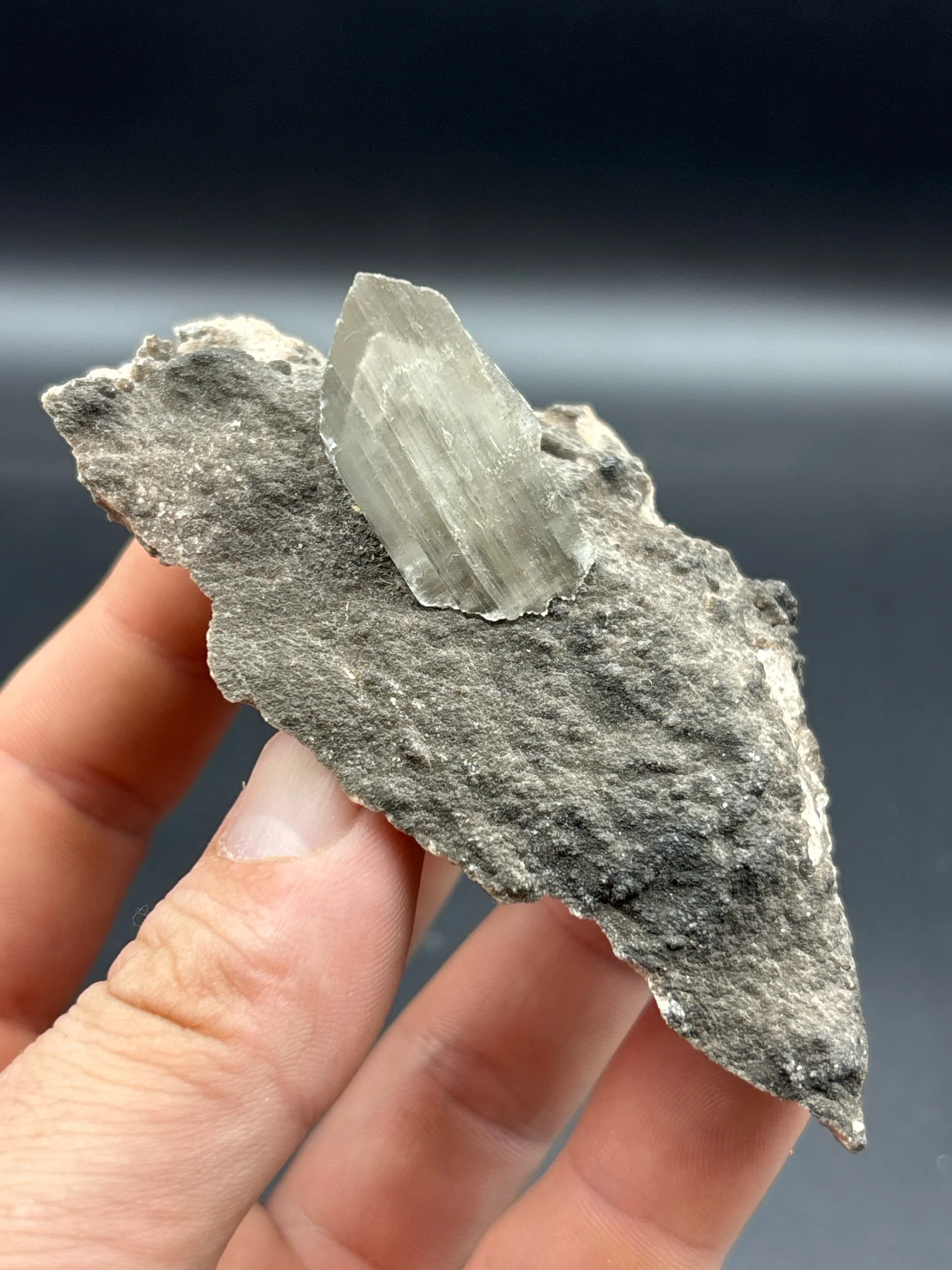
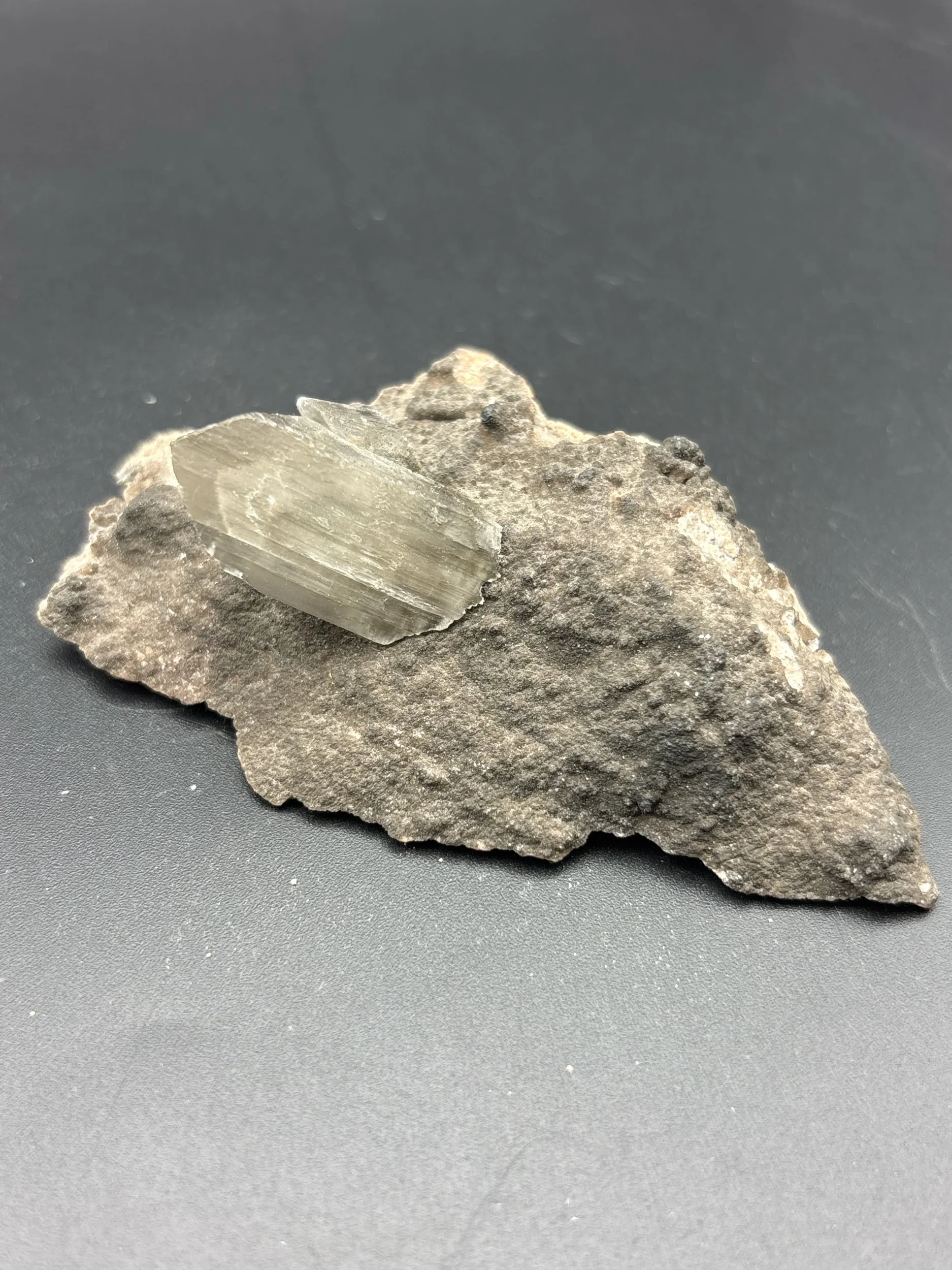
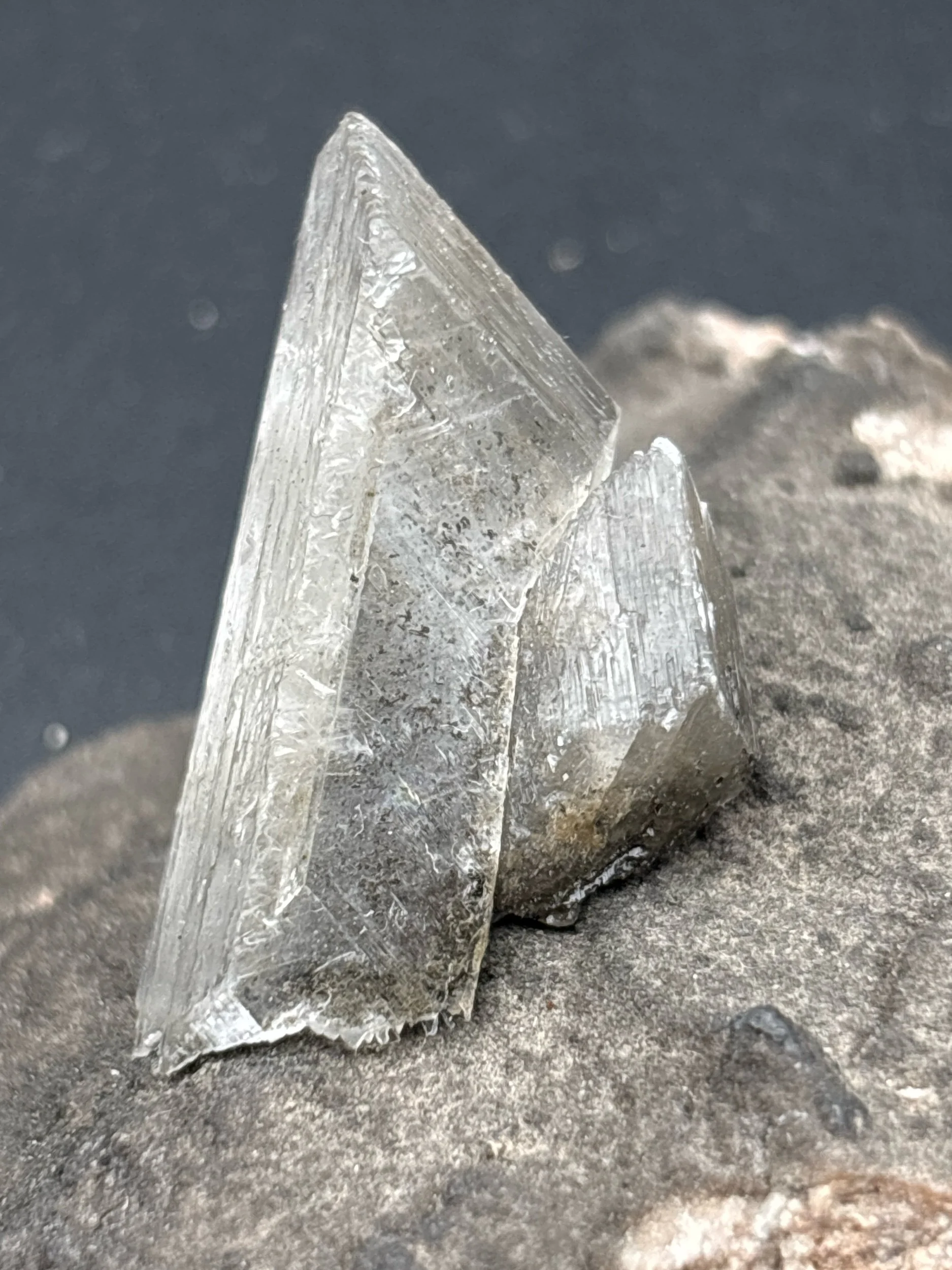
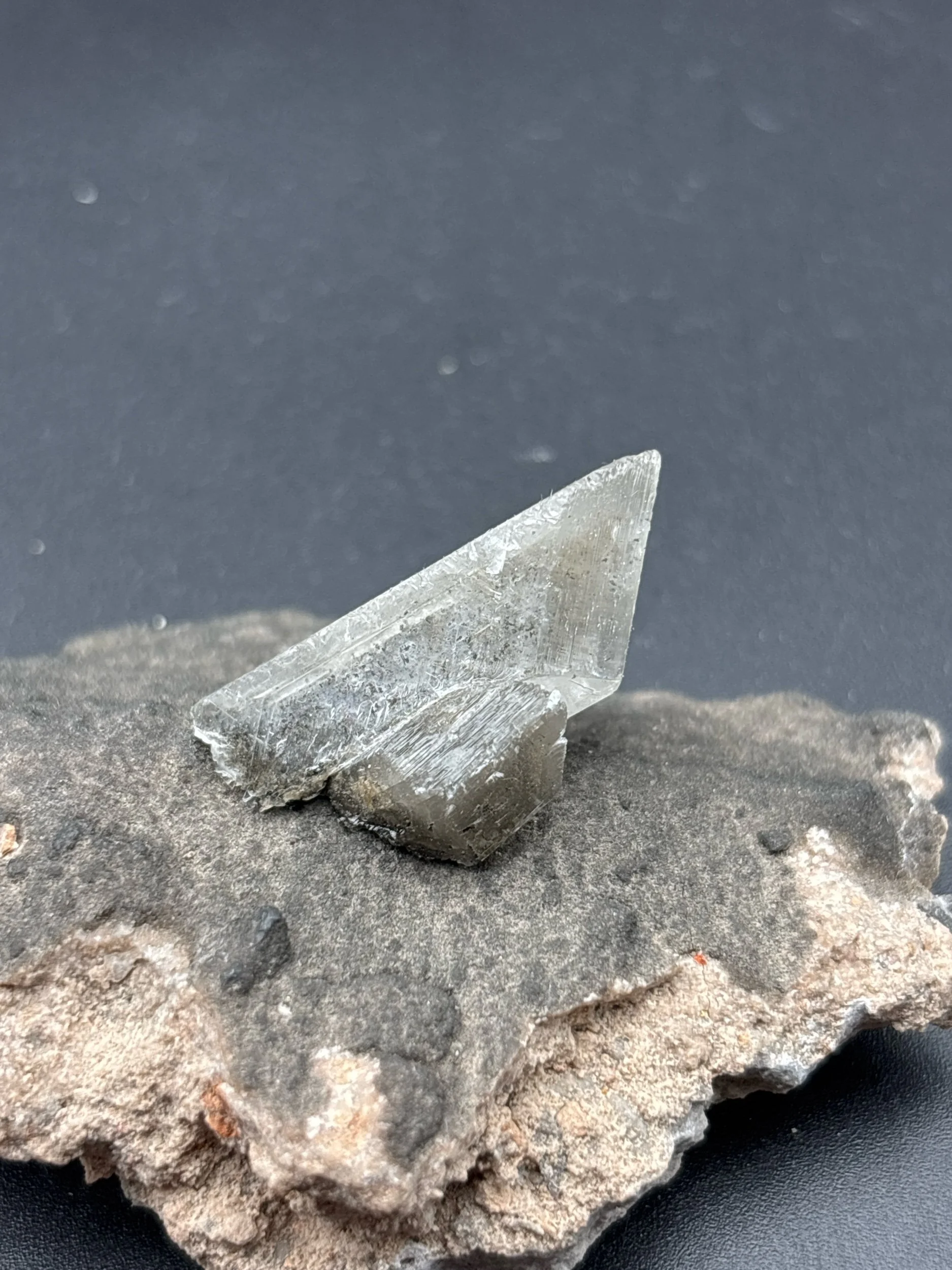
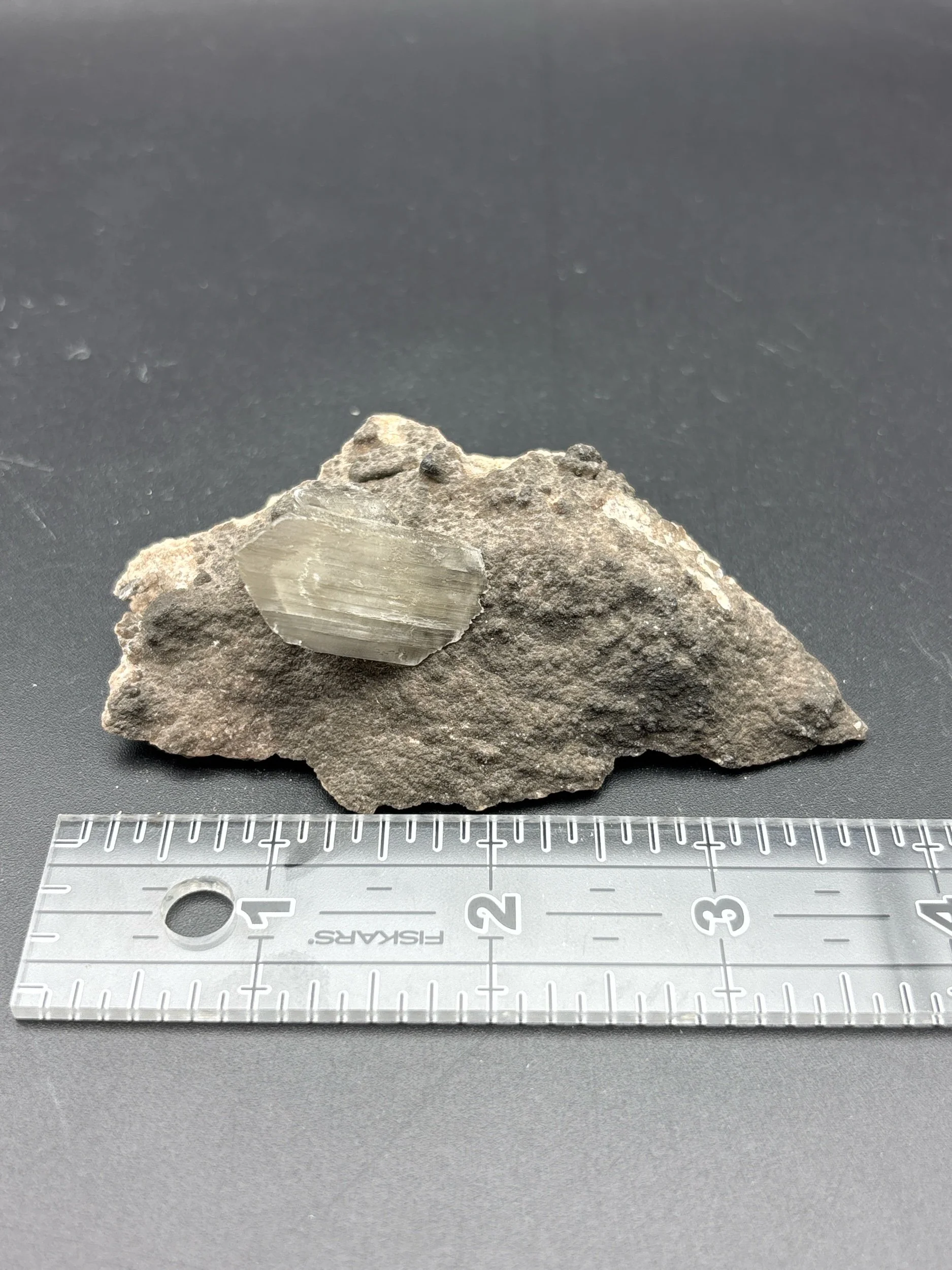
Mining at Naica, Chihuahua, Mexico, began in the late eighteenth century and developed primarily around its lead, zinc, silver, and other metallic ores rather than selenite. During the expansion of underground workings in the early twentieth century, miners encountered caves containing large, transparent selenite crystals, including the famous Cave of Swords discovered in 1910. Continued mine development and dewatering led to the discovery of the Cave of Crystals in 2000, where gypsum crystals exceeding 11 meters in length represent some of the largest known natural crystals on Earth. Although these spectacular crystals were exposed through mining, they were not the primary object of extraction, and many Naica selenite specimens available to collectors originated from smaller cavities elsewhere in the mine rather than from the famous Cave of Crystals.
This specimen is a beautiful example of selenite with excellent isolation on matrix.
Thank you so much for viewing! Please message for any further information
(3.8 × 2.0 × 2.2 in - 9.6 × 5.0 × 5.5 cm) 3.1oz / 87g
Orders ship Mondays
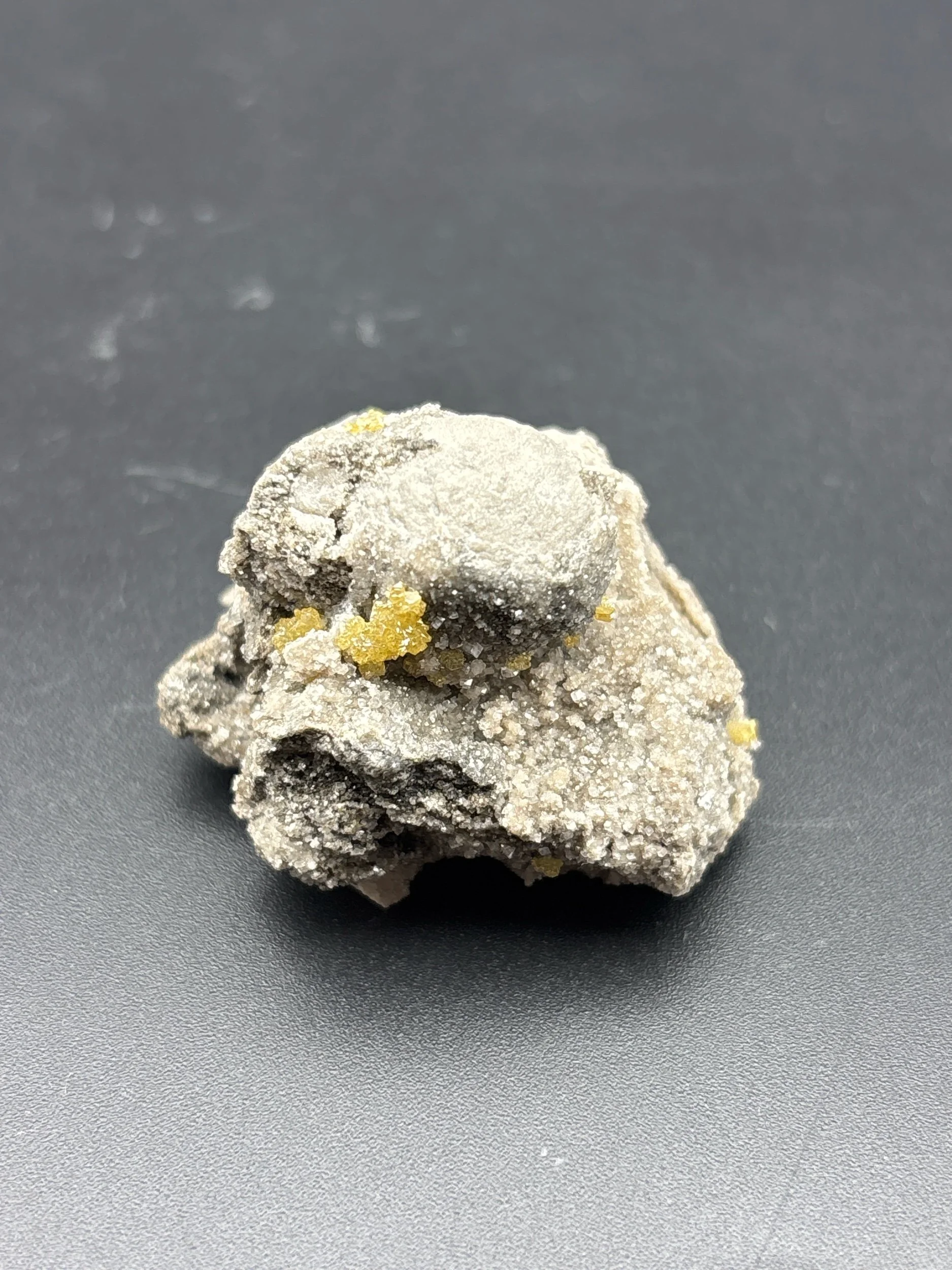
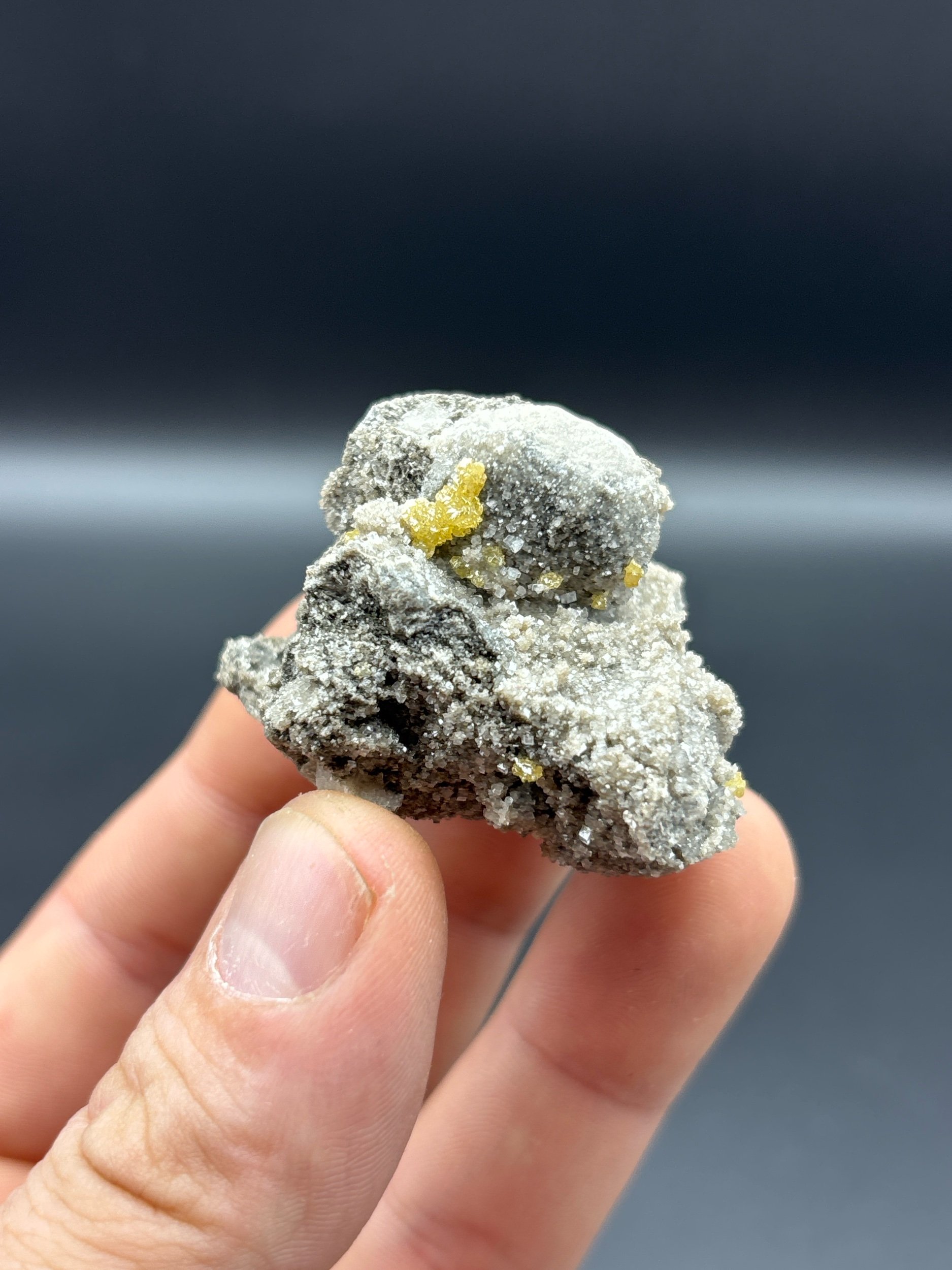
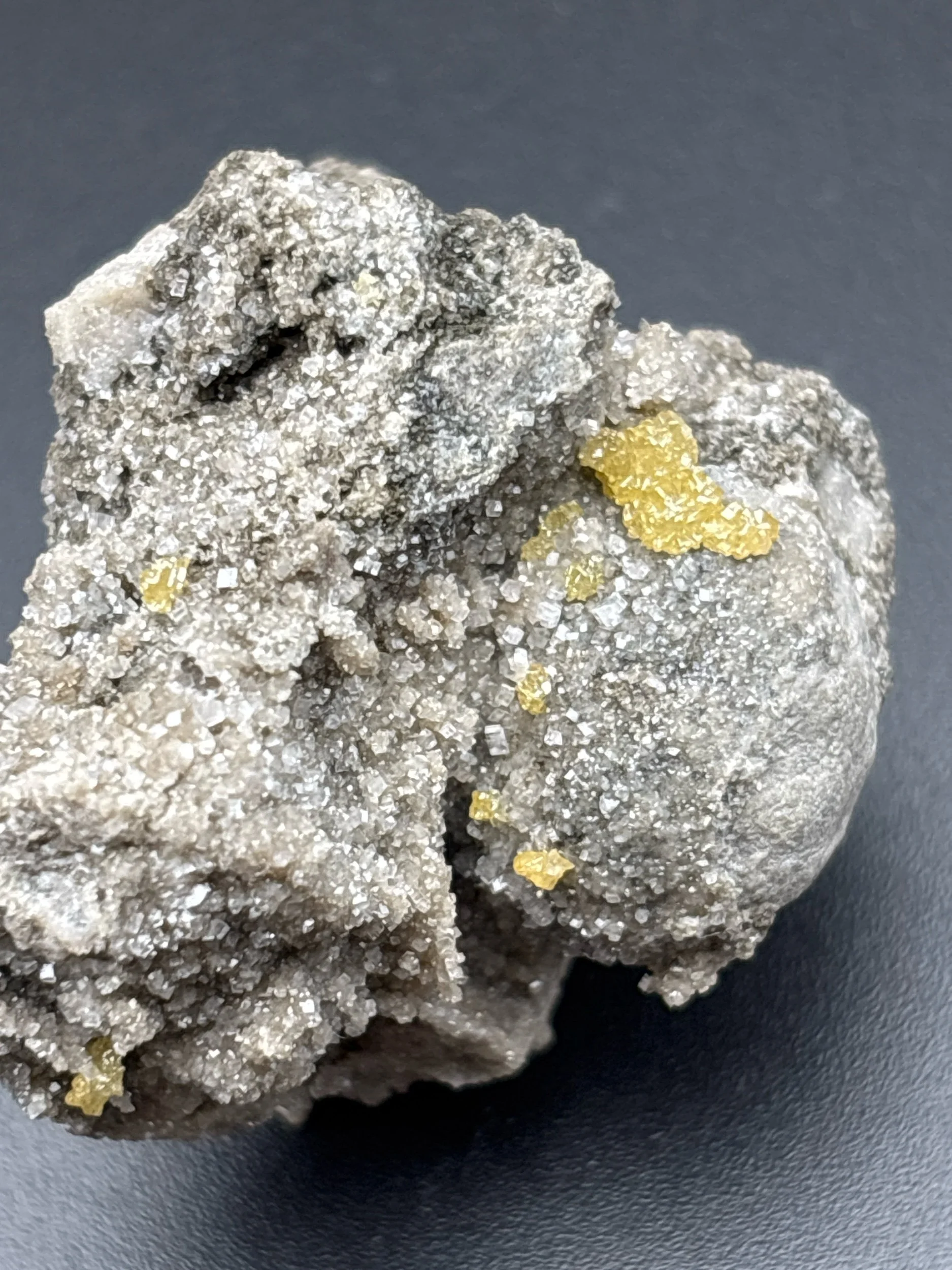
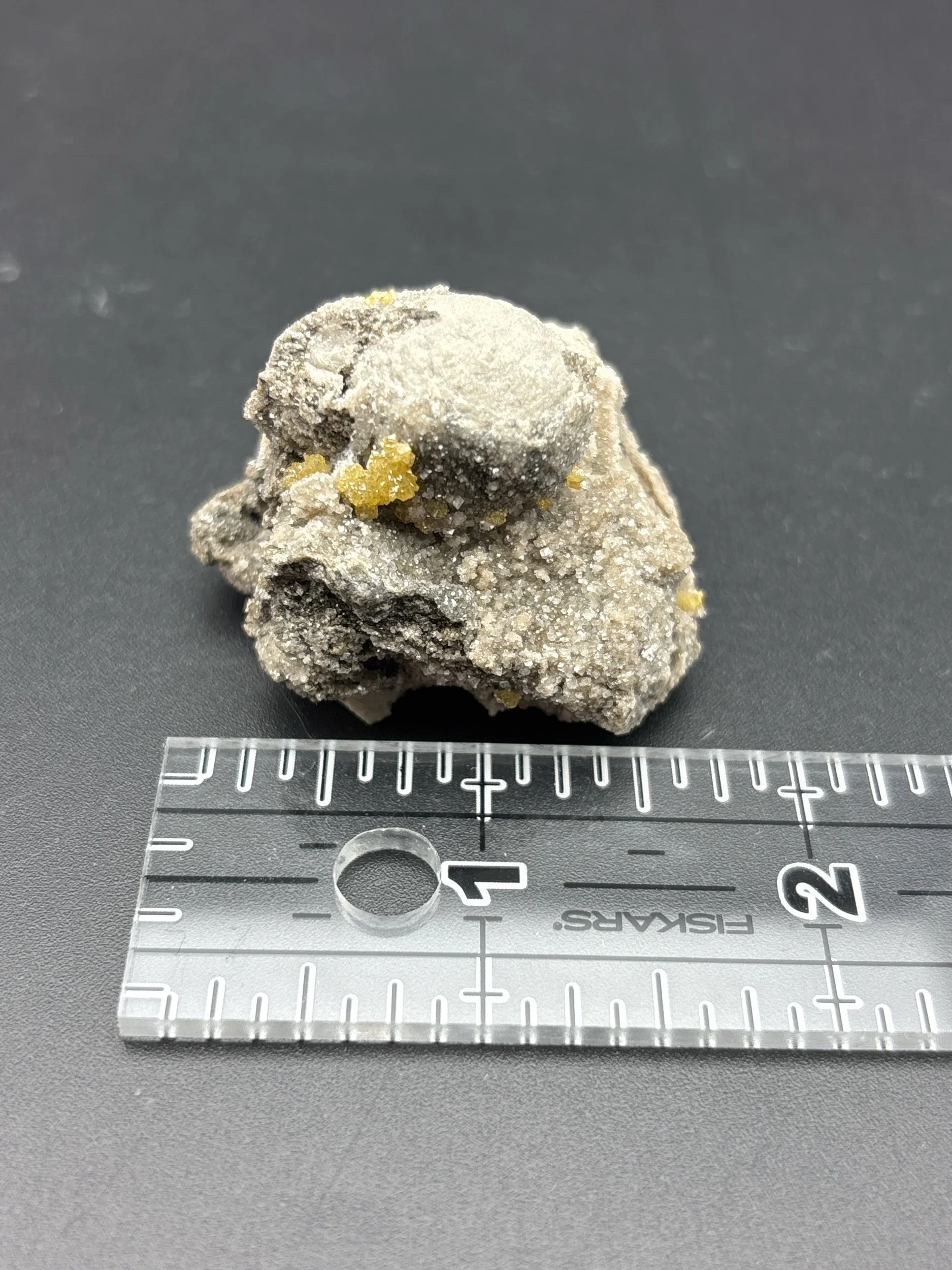
The Holcim Quarry in Lockport, New York, is a well-known collecting site developed in Silurian-aged dolostone of the Niagara Escarpment. It has produced a wide range of mineral specimens, most notably well-formed dolomite crystals along with calcite, fluorite, sphalerite, and occasional galena. Many of these minerals occur lining vugs and fractures, often showing sharp crystal form and attractive color contrasts. Access has been limited in recent years, but material from the quarry remains widely represented in both private and museum collections.
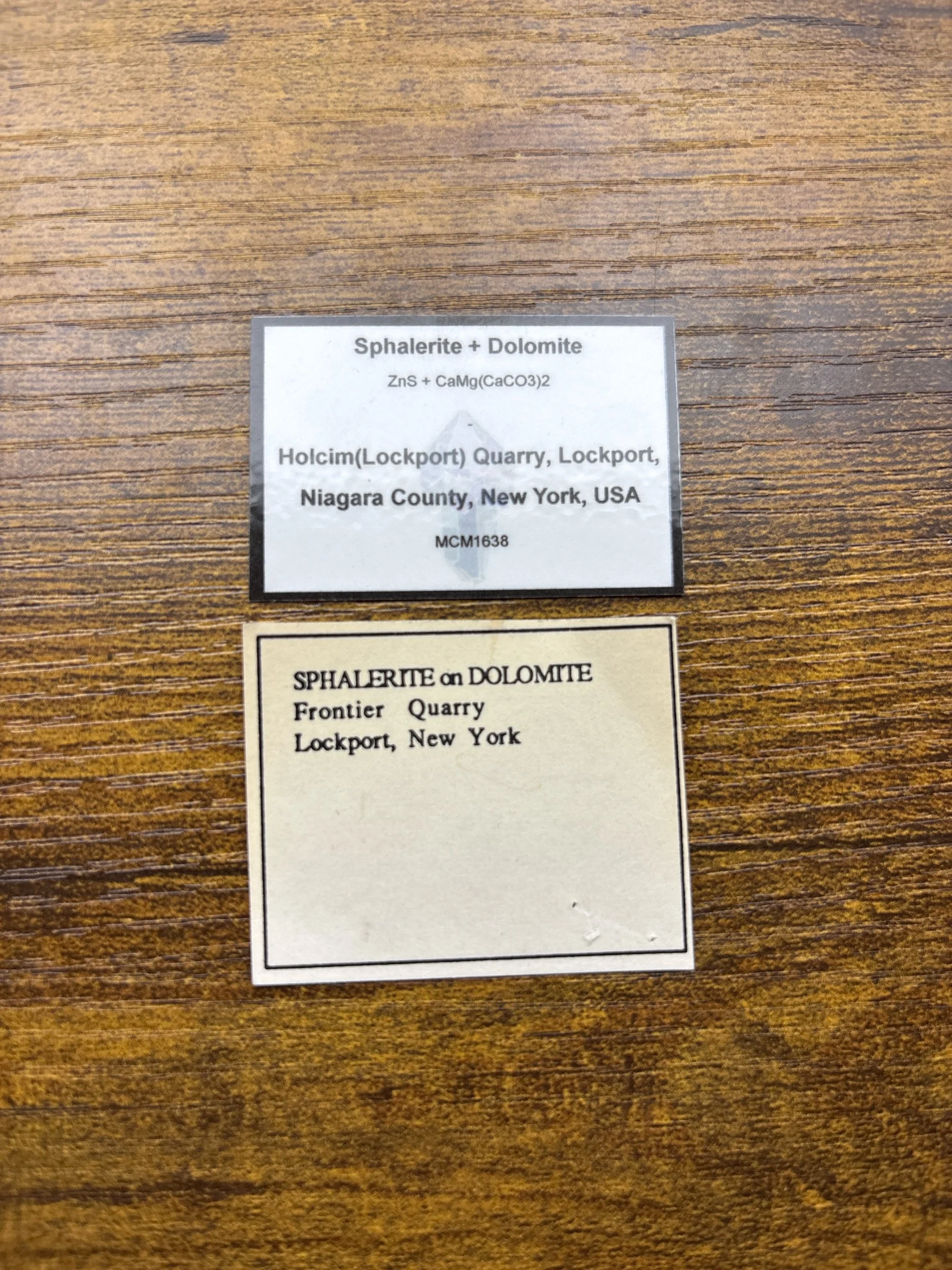
This specimen is a classic miniature example of dolostone matrix hosting small yellow sphalerite crystals. the crystals are extremely fluorescent orange under long wave(365nm) light. This attractive specimen displays naturally quite well and is a wonderful example of historic New York locales. Accompanied by an older generic label.
Thank you so much for viewing! Please message for any further information
(1.7 × 1.6 × 1.4 in - 4.3 × 4.0 × 3.5 cm) 1.7oz / 50g
ORDERS SHIP MONDAYS
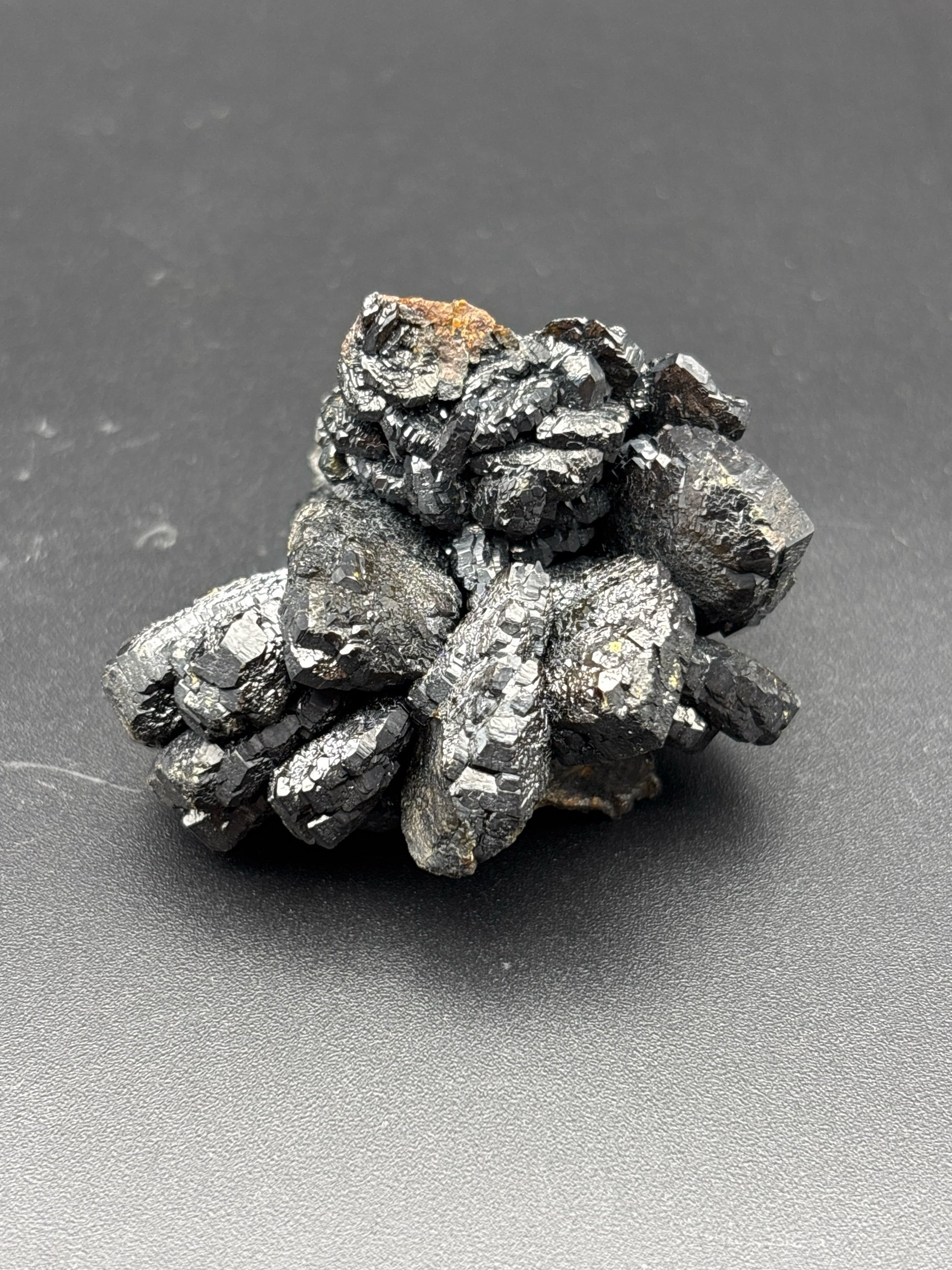
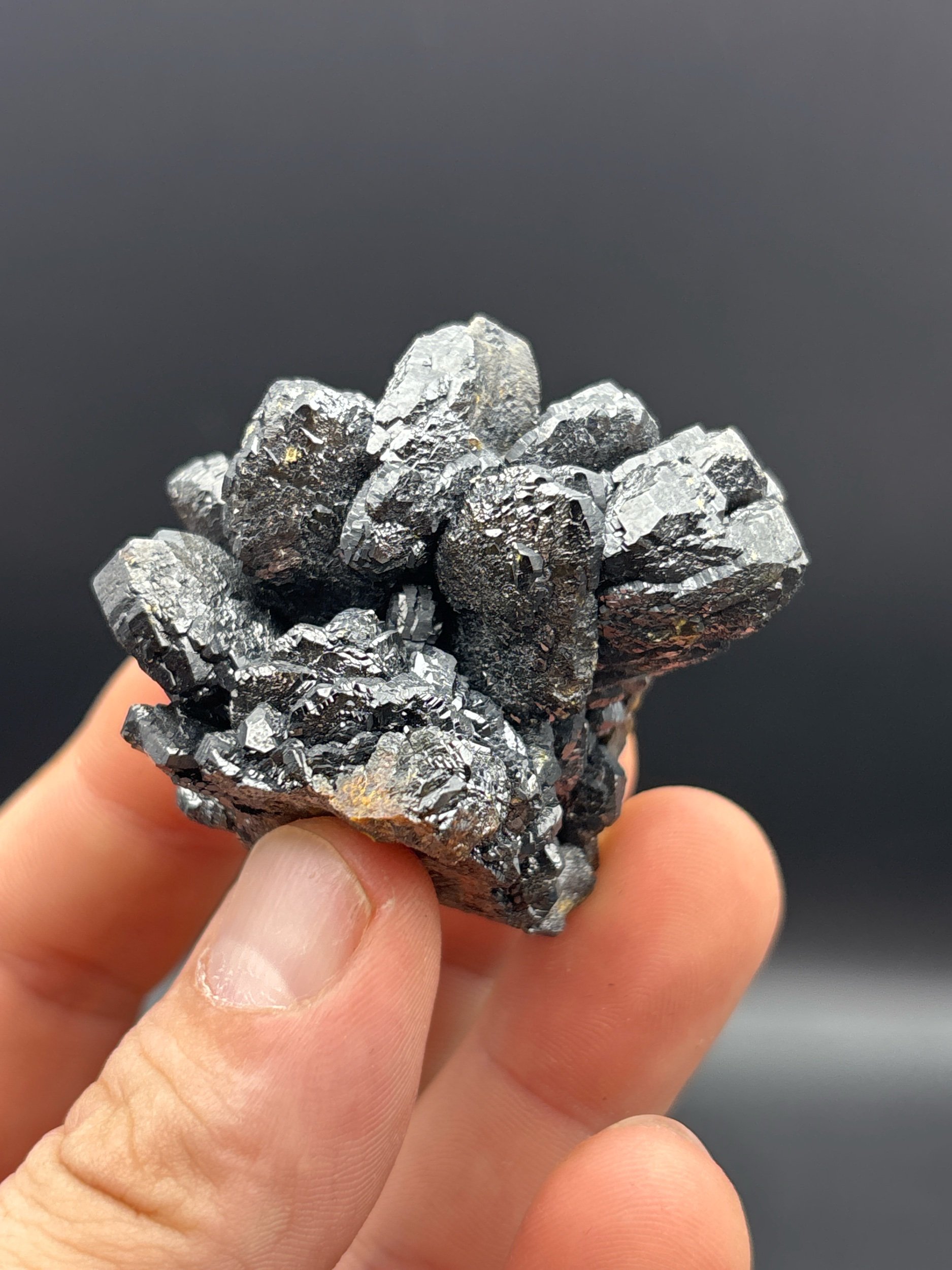
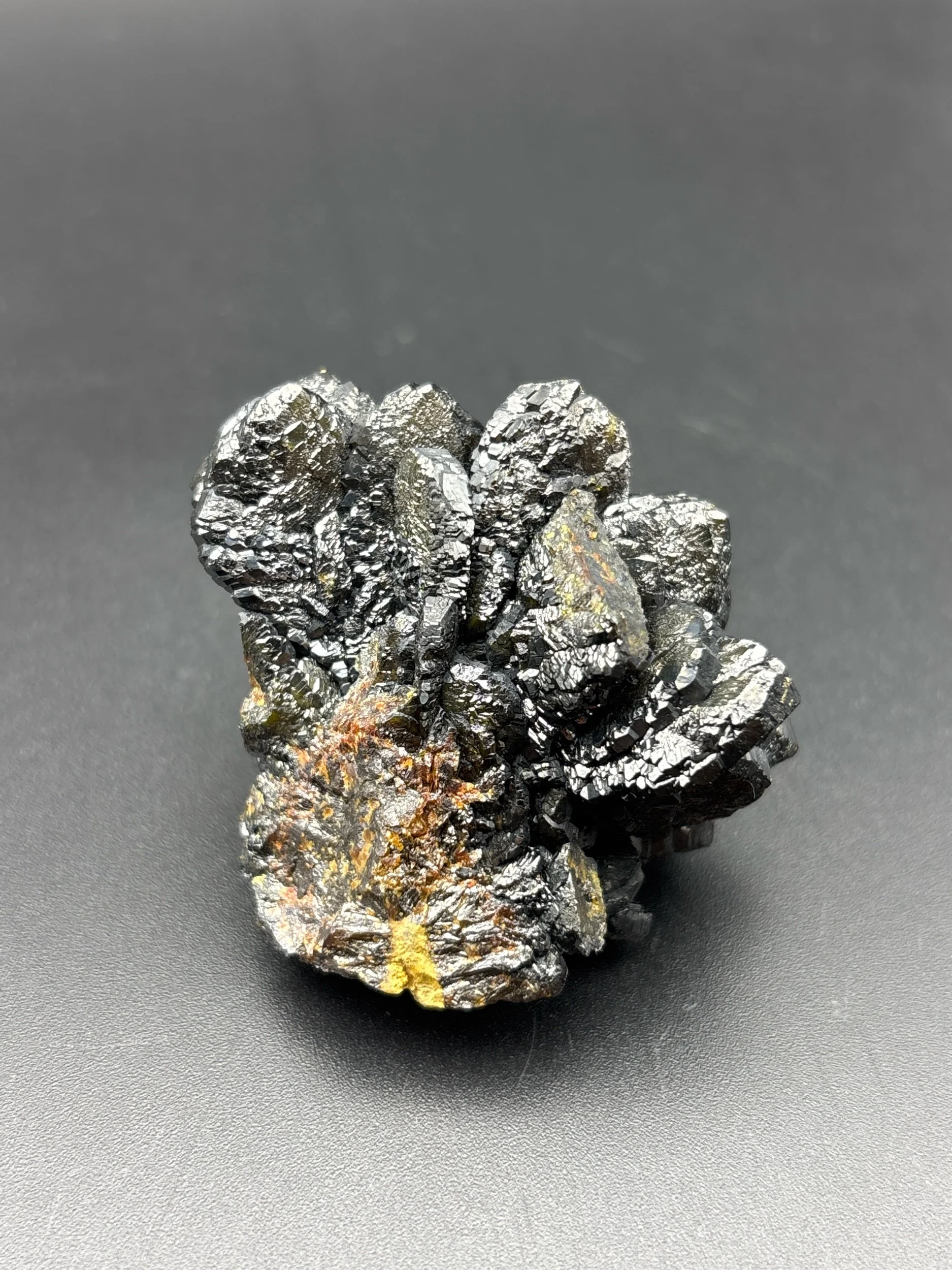
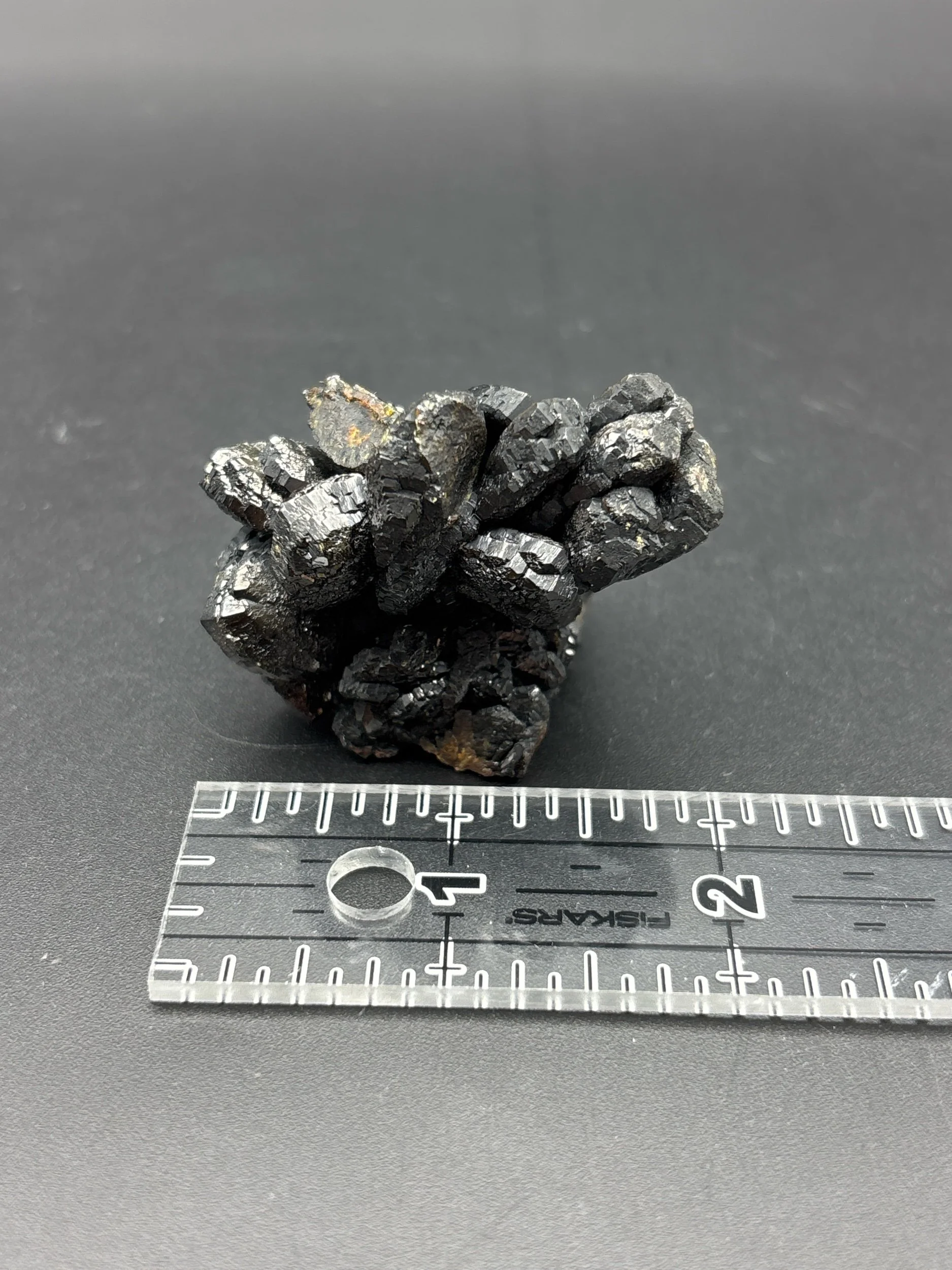
Berg Aukas is a historic mineral deposit located in northern Namibia, about 40 km south of the town of Grootfontein. Geologically, the deposit is a hydrothermal lead-zinc-vanadium ore body hosted in dolostone of the Neoproterozoic Otavi Group. Mineralization formed when metal-rich fluids moved through fractures and dissolution cavities in the carbonate rocks, depositing sulfide minerals such as galena and sphalerite along with unusual secondary minerals. The mine is especially famous for producing rare vanadium minerals, including the bright red lead vanadate descloizite and other colorful oxidation-zone species that formed when the ore was exposed to weathering.
Mining at Berg Aukas began in 1913 and expanded significantly during the mid-1900s, eventually becoming one of the world’s most important sources of vanadium-bearing minerals. Although commercial mining ceased in 1978, Berg Aukas remains well known among geologists and mineral collectors for its exceptional mineral diversity and specimen quality.
This specimen is a cluster of large blocky descloizite crystals clustered together across the matrix. Carrying with it a Scott Rosenthal label, which dates to modern times. Largely, the display area is in good condition with excellent luster.
Thank you so much for viewing! Please message for any further information
(2.0 × 1.8 × 1.5 in - 5.0 × 4.5 × 3.8 cm) 5.4oz / 153g
Orders ship Mondays


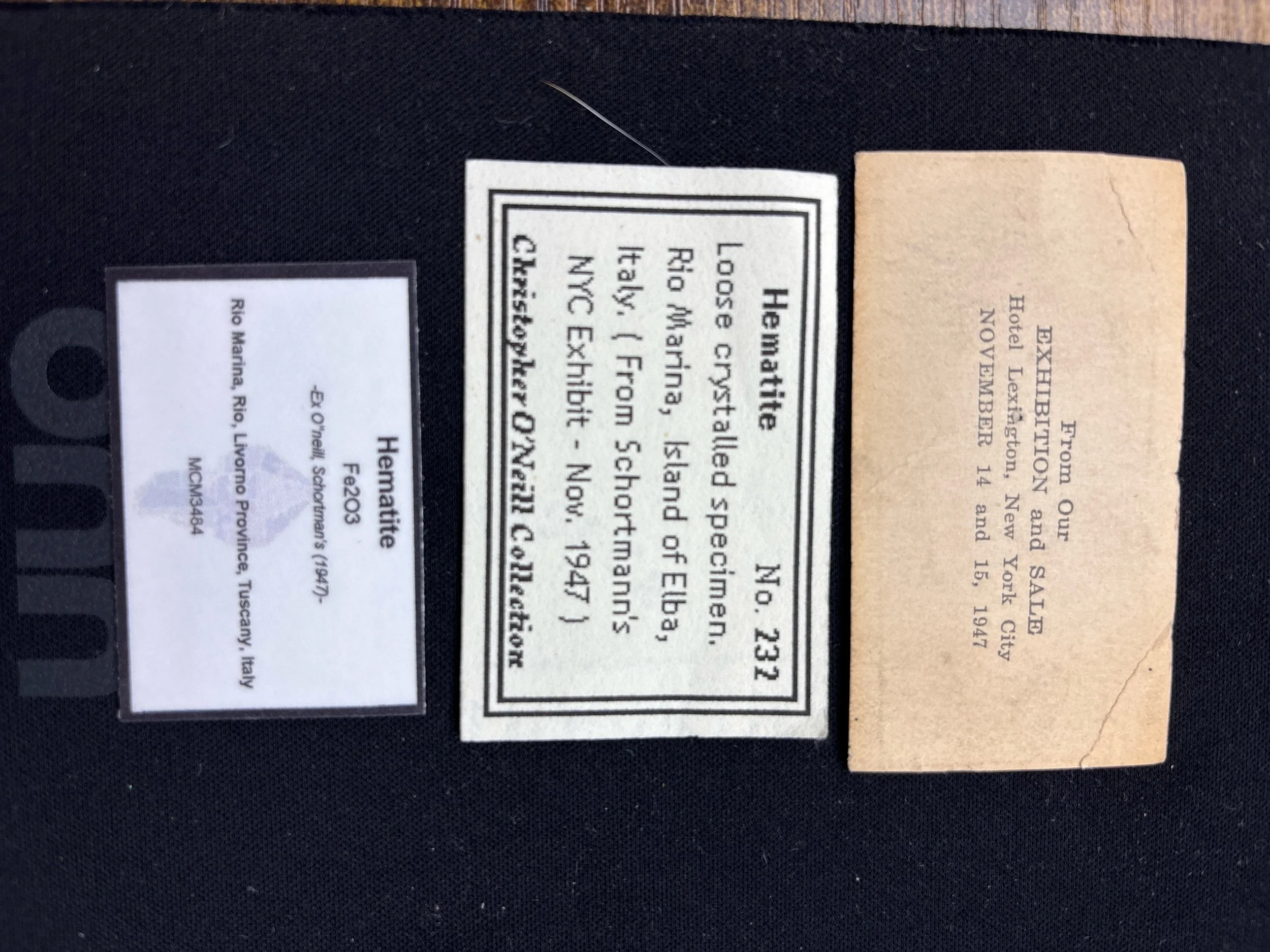
Small town and former commune (municipality) on the northeast coast of Elba; on its territory are the iron mines exploited since Etruscan times.
This specimen is a piece of history. The Schortman’s label denotes it being sold at their november 1947 Exhibition and sale in New York. Followed by a Christopher O’Neill label (#232), a collection renowned for high quality thumbnails and miniatures. The back of Chris’s label notes he obtained it from LHC in 2005, likely Lawrence H Conklin. It is an otherwise classic and typical example of the ancient iron mines of Rio Marina!
Thank you so much for viewing! Please message for any further information
(1.5 × 0.9 × 0.7 in - 3.8 × 2.2 × 1.7 cm) 1.1oz / 32g
Orders ship Mondays


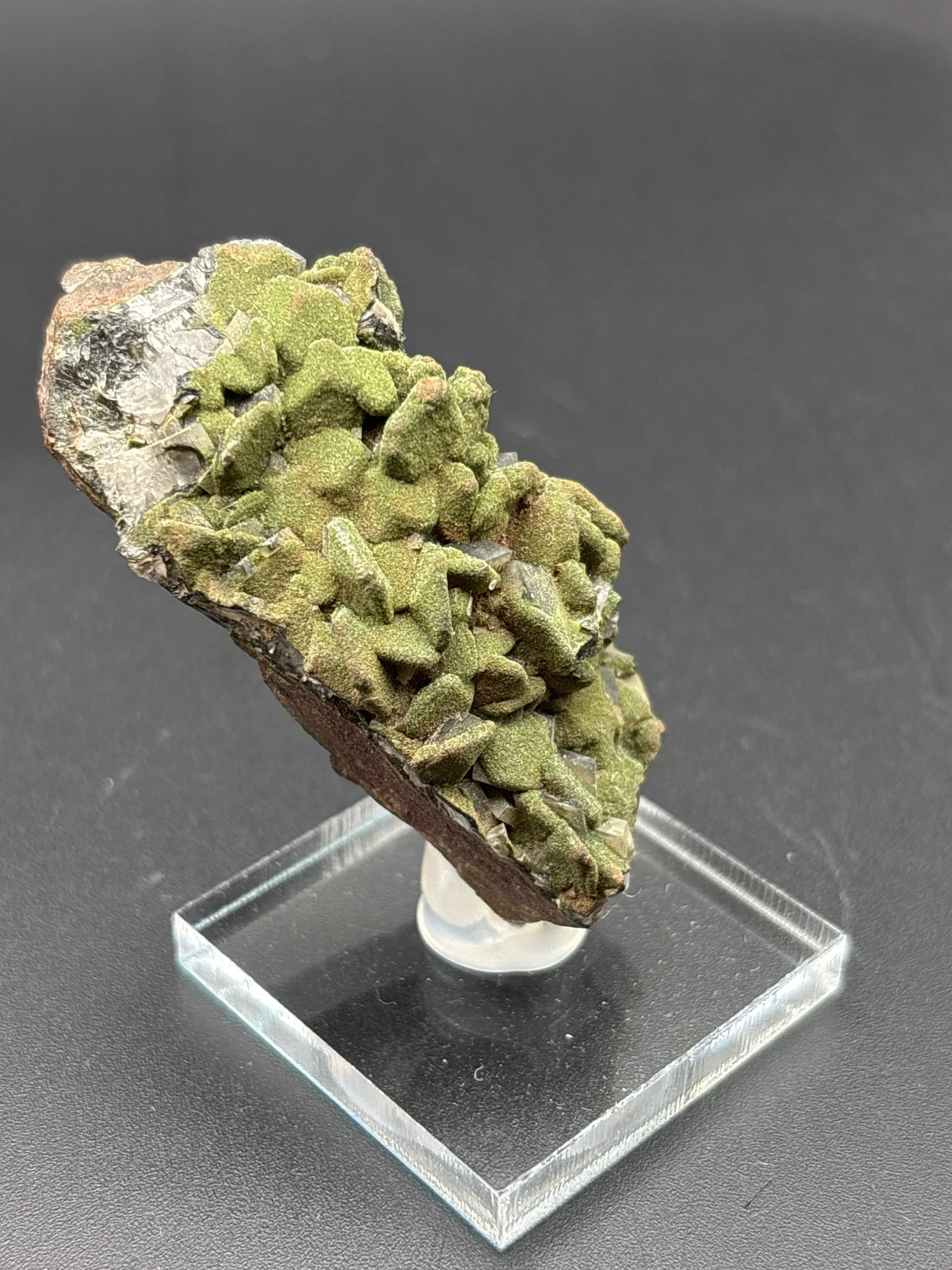
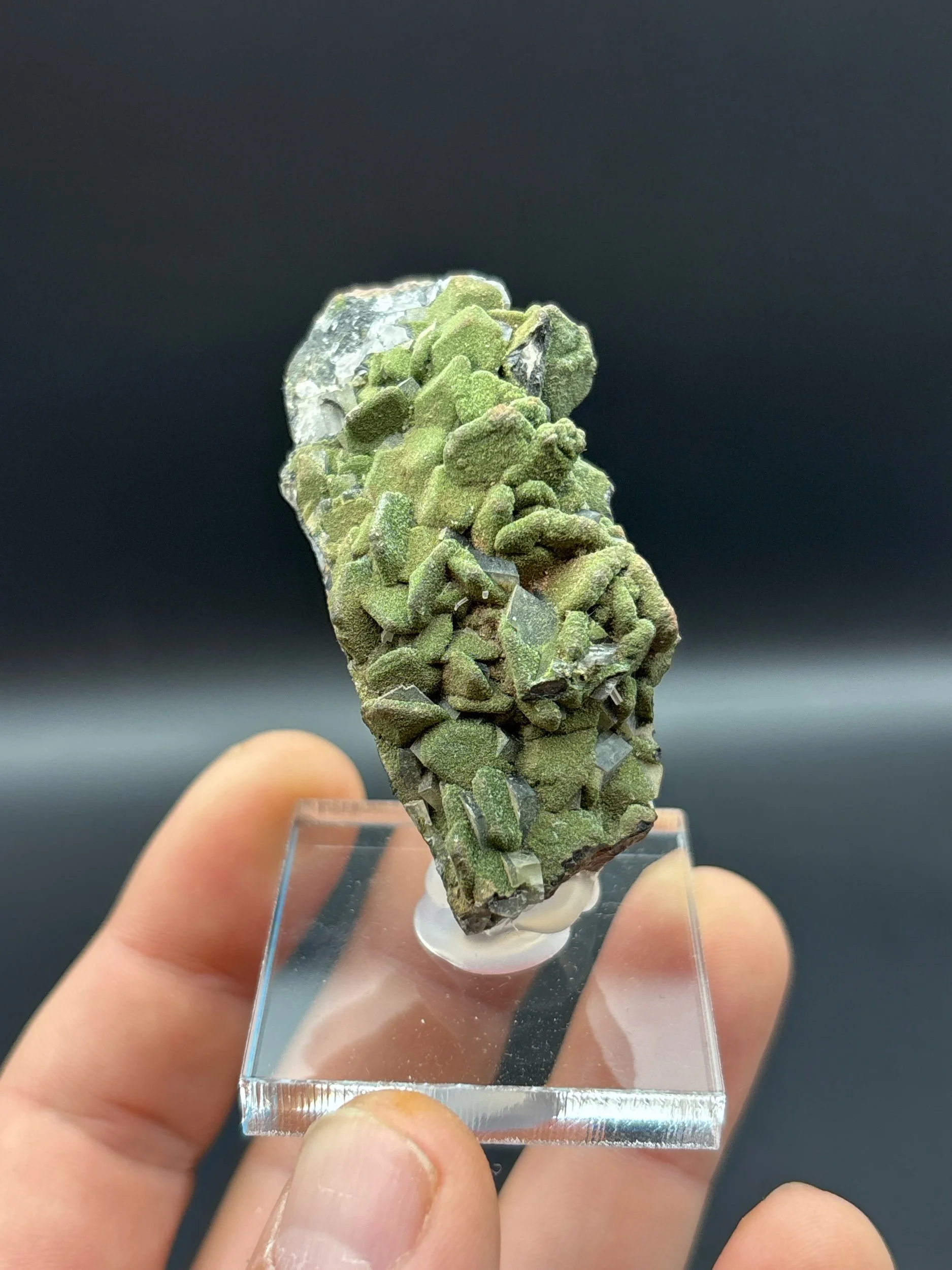
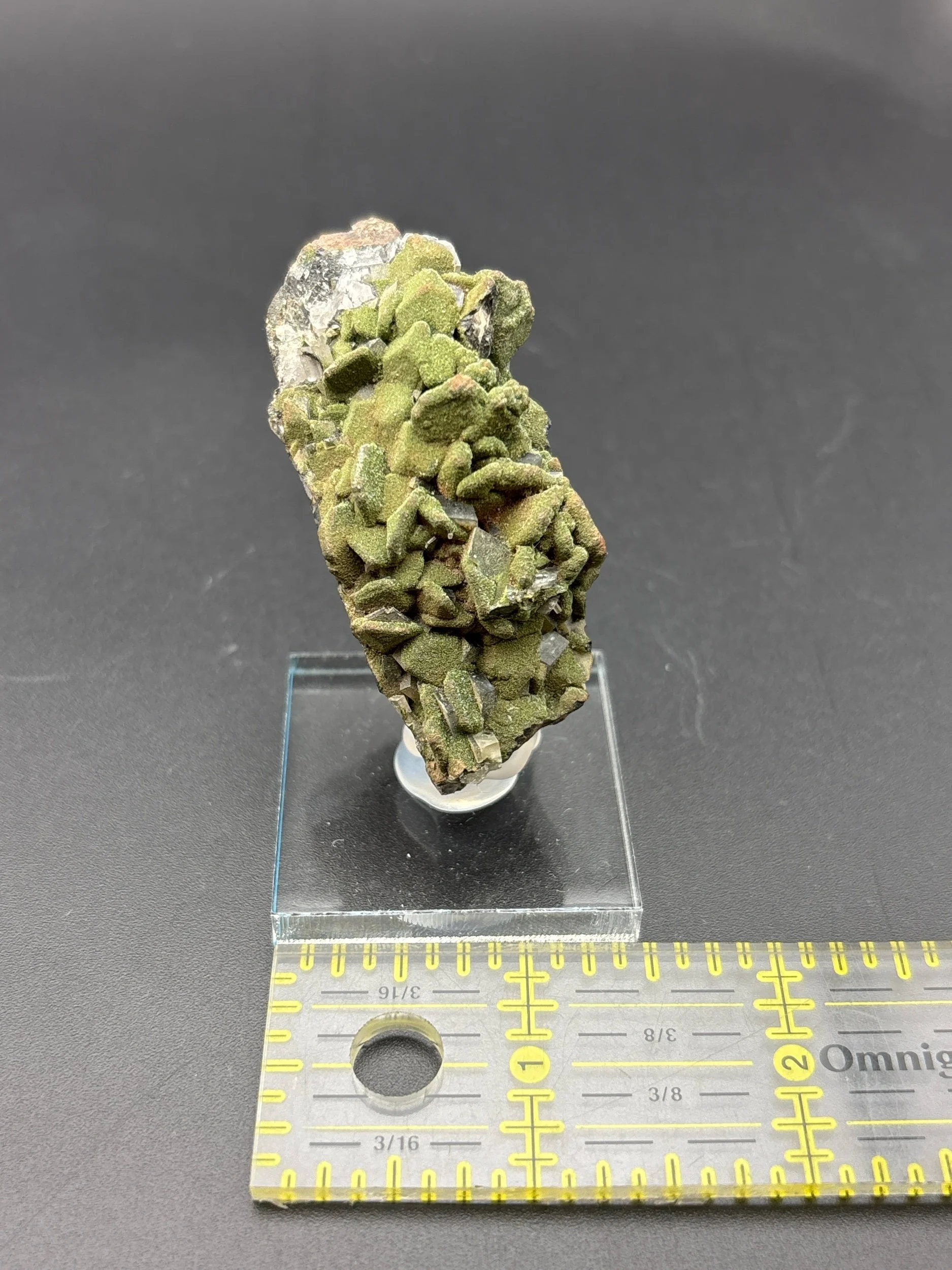
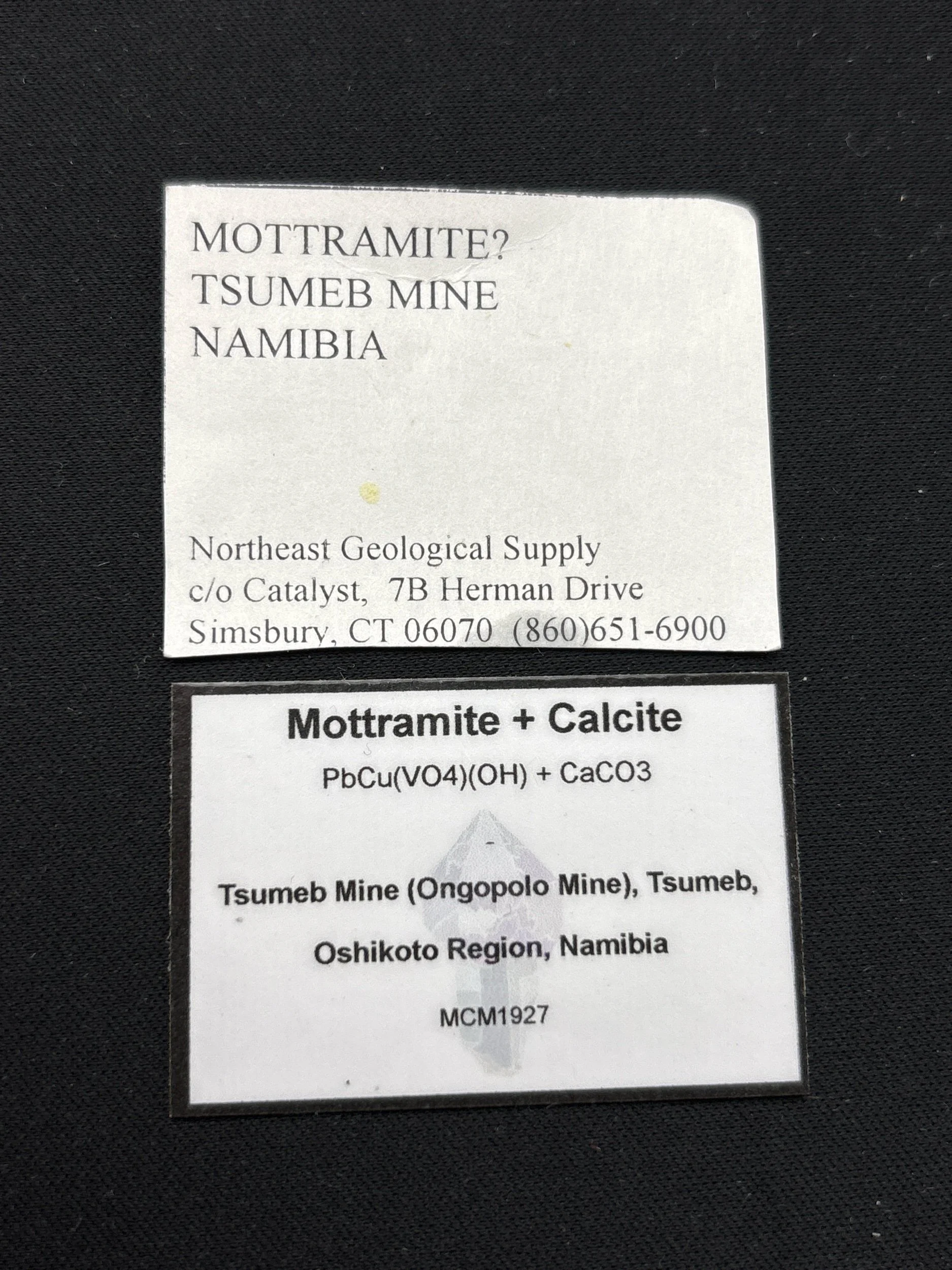
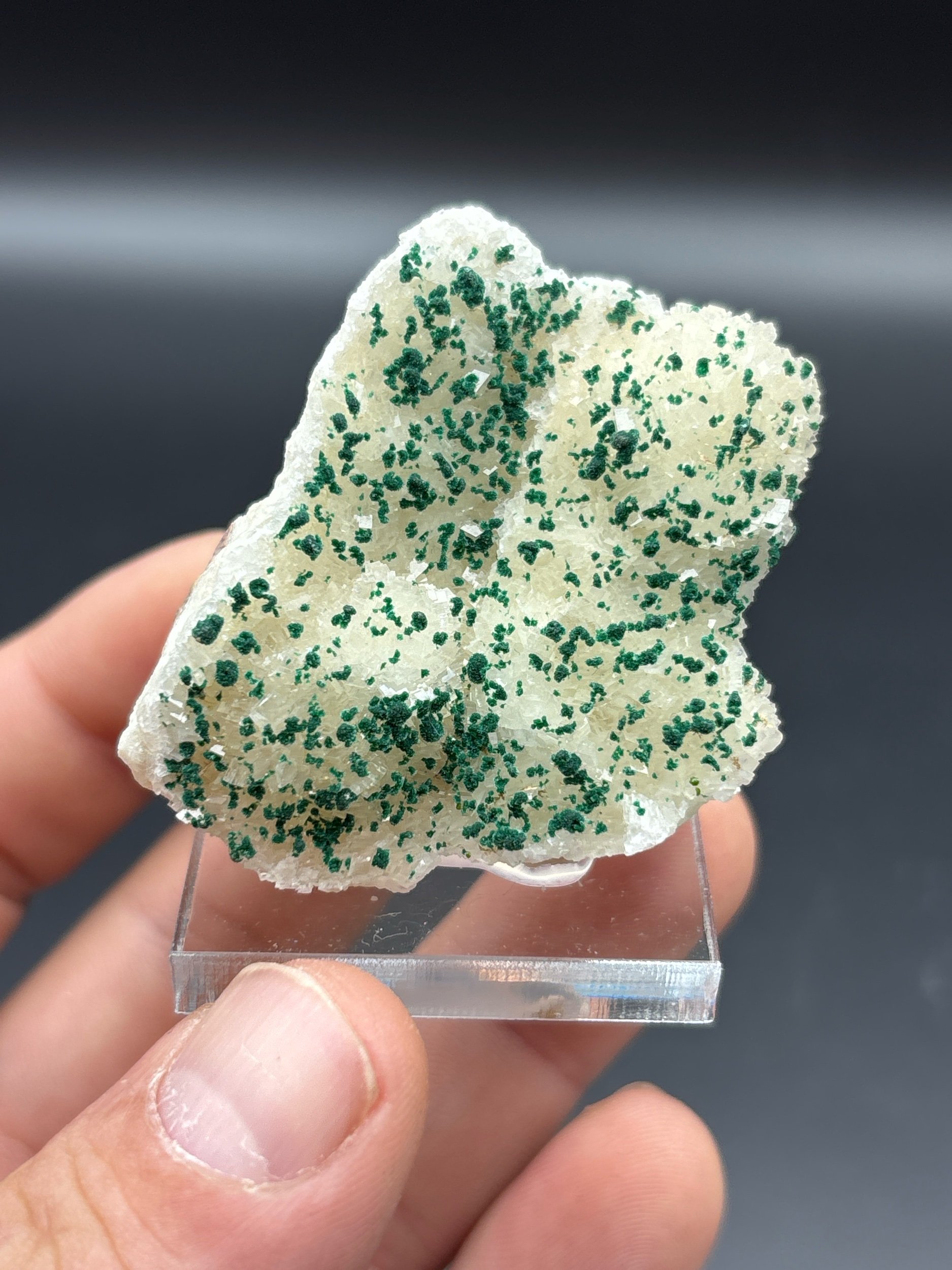
The Tsumeb mine is regarded in the mineral collecting world by many as the greatest locality overall. Including a wide range of species, rich history, and type locale specimens, the depth of collectability often goes far beyond the visual appeal. The mine was first discovered on January 21, 1893, by Matthew Rogers. It was initially described as “The Green Hill”. The mine would operate for just over a century, shutting down in 1996 for economic reasons. Tsumeb is considered a world-class quality producer of Adamite, Azurite, Cerussite, Dioptase, Mimetite, Tennantite, and many other species. It is home to 76 Type Locality Minerals.
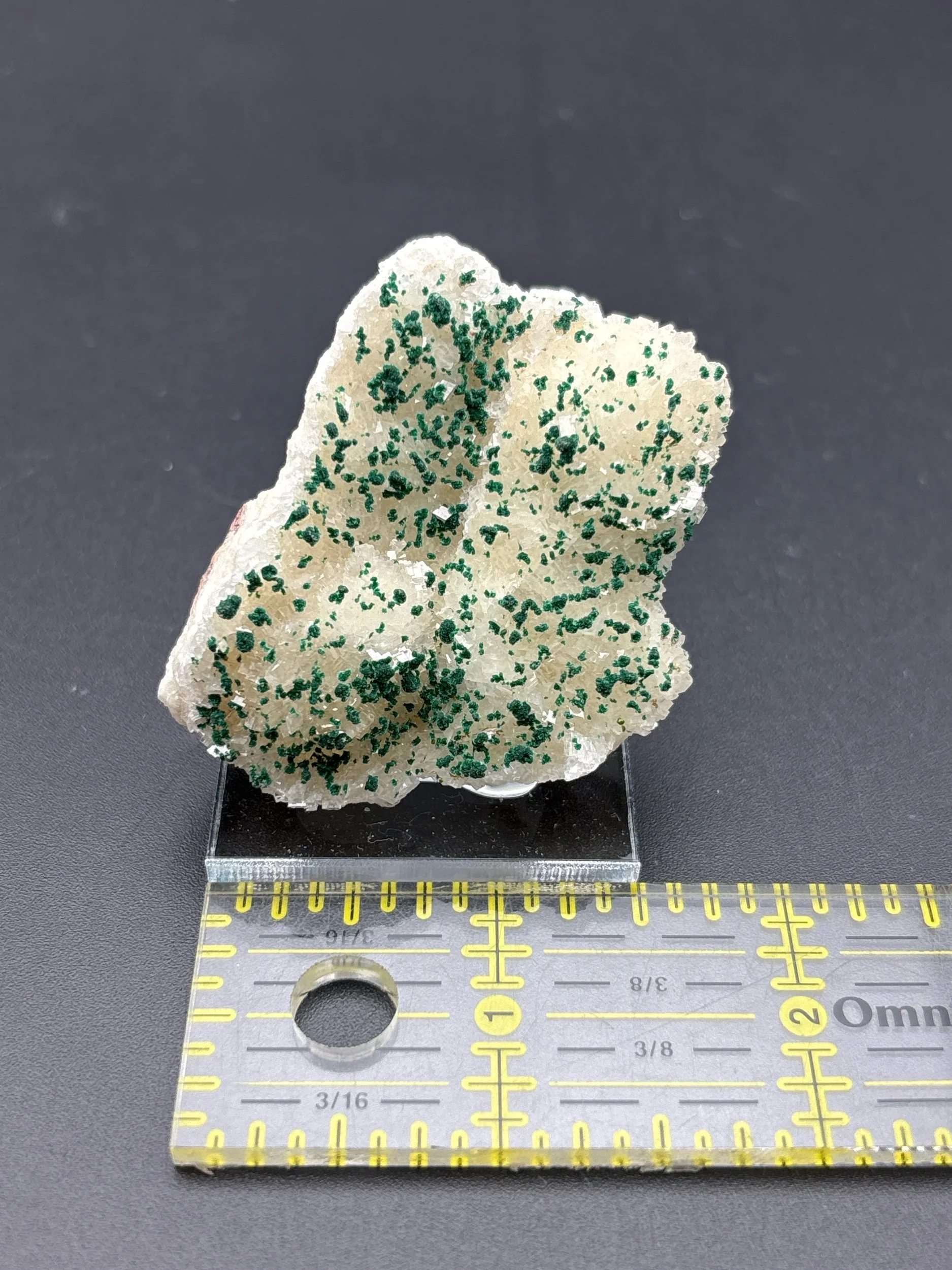
A rich and beautiful cluster of mottramite coating white calcite! The deep green of this specimen is remarkable and striking. The calcite crystals are entirely coated but still display crystal habit. Mounted to an acrylic base and accompanied by dealer label from Northeast Geological Supply
Thank you so much for viewing! Please message for any further information
(1.3 × 2.3 × 1.0 in - 3.3 × 5.8 × 2.5 cm) 2.3oz / 66g (with base)
ORDERS SHIP MONDAYS

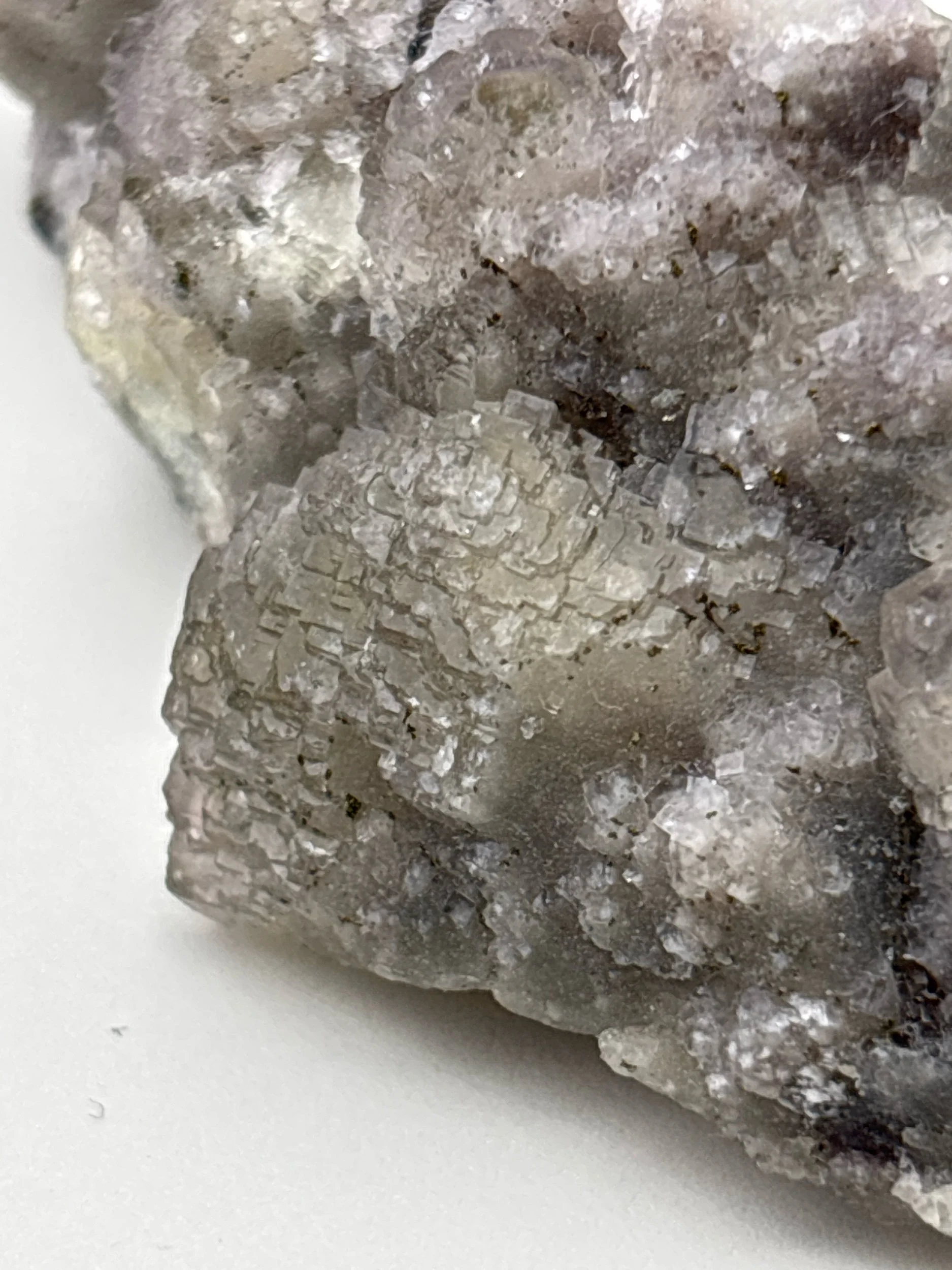
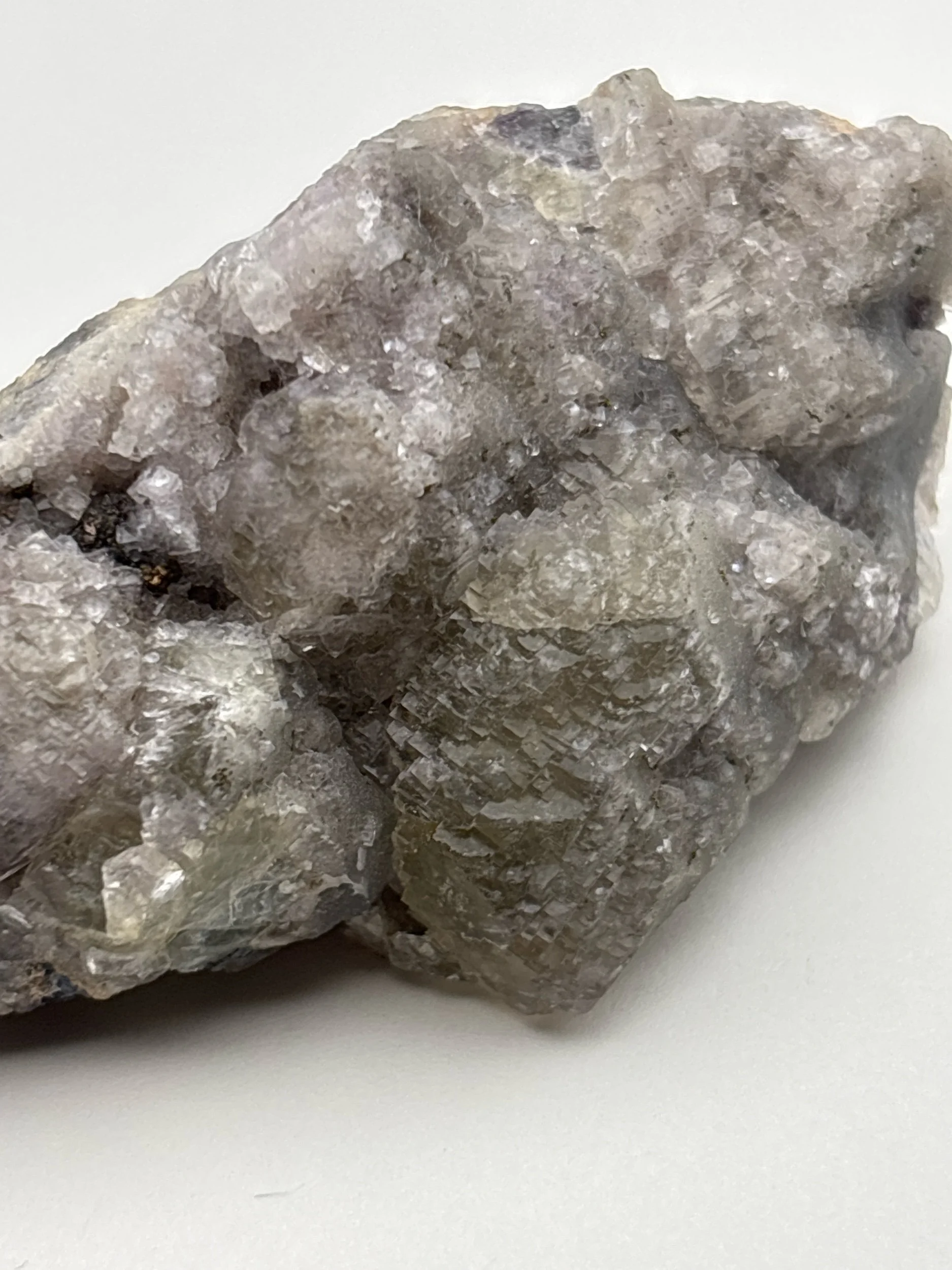


The many mines of Butte amount to over 11,000 miles of workings below the city. Without specific provenance, it’s nearly impossible to associate specimens with specific mines. The “richest hill on earth” first originated as a mining camp for gold but would later rapidly develop into one of the world’s most historic sulfide deposits. Rich veins of covellite, chalcocite, enargite, and other minerals as thick as 100 feet were stoped out, supplying the world with a large portion of its industrial copper.
This is a fairly simple, yet exceedingly rare example of fluorite from Butte. Seldom found available to collectors, Butte fluorite is one of the elusive species from the supergene polymetallic deposit that was observed in very minute quantities at best. Complex stepping is present across most faces, with strong fluorescence in ultraviolet light. I note 5 distinct crystal nucleation sites, intergrown together to almost entirely coat the matrix, of which small quartz and chalcopyrite can be seen.
Thank you so much for viewing! Please message for any further information
(2.4 × 1.2 × 1.3 in - 6.0 × 3.0 × 3.3 cm) 1.9oz / 55g
ORDERS SHIP MONDAYS
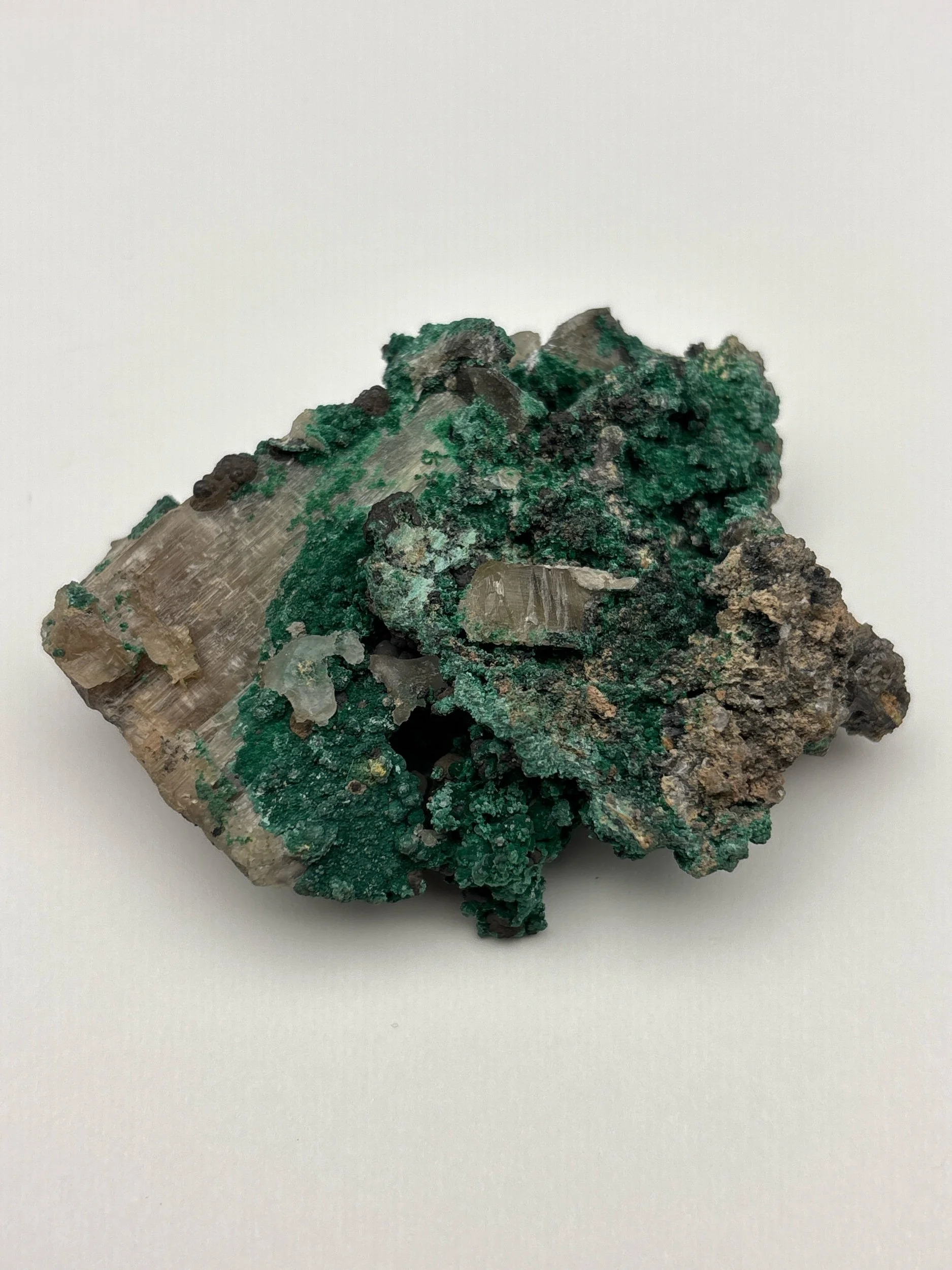


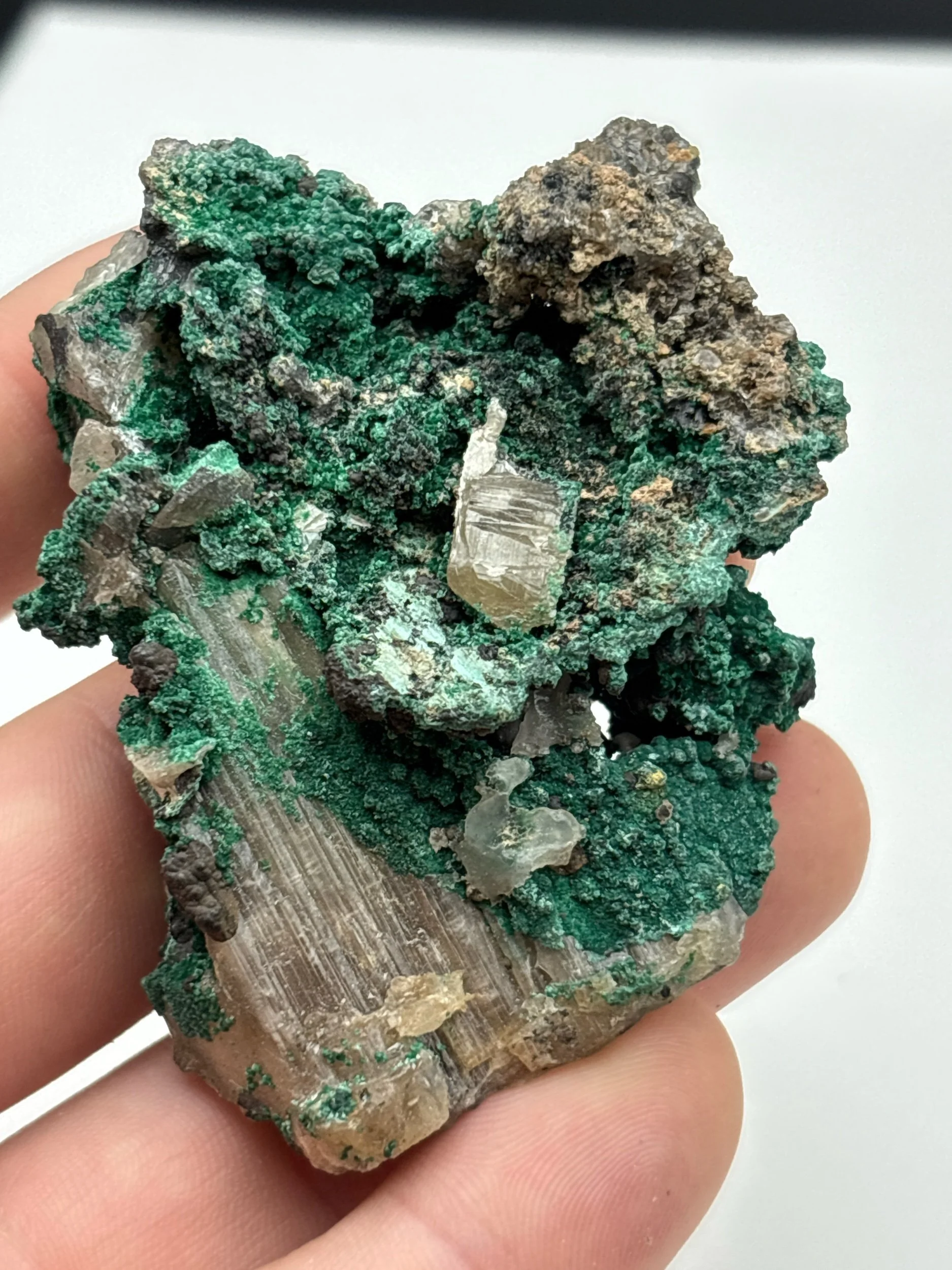

The Rum Jungle mine, located in Australia’s Northern Territory, is historically significant for both its uranium production and its diverse suite of secondary mineral specimens formed through extensive weathering processes. Oxidation of sulfide-rich ore bodies produced an array of visually distinctive minerals, including malachite, azurite, brochantite, and other copper-bearing alteration products highly valued by mineral collectors.
This is an absolutely classic example of malachite and cerussite intergrown with minor psilomelane present as well. The cerussite exhibits offset reticulation when view at the proper angle.
Thank you so much for viewing! Please message for any further information
(2.9 × 2.3 × 0.9 in - 7.3 × 5.8 × 2.2 cm) 2.7oz / 78g
ORDERS SHIP MONDAYS
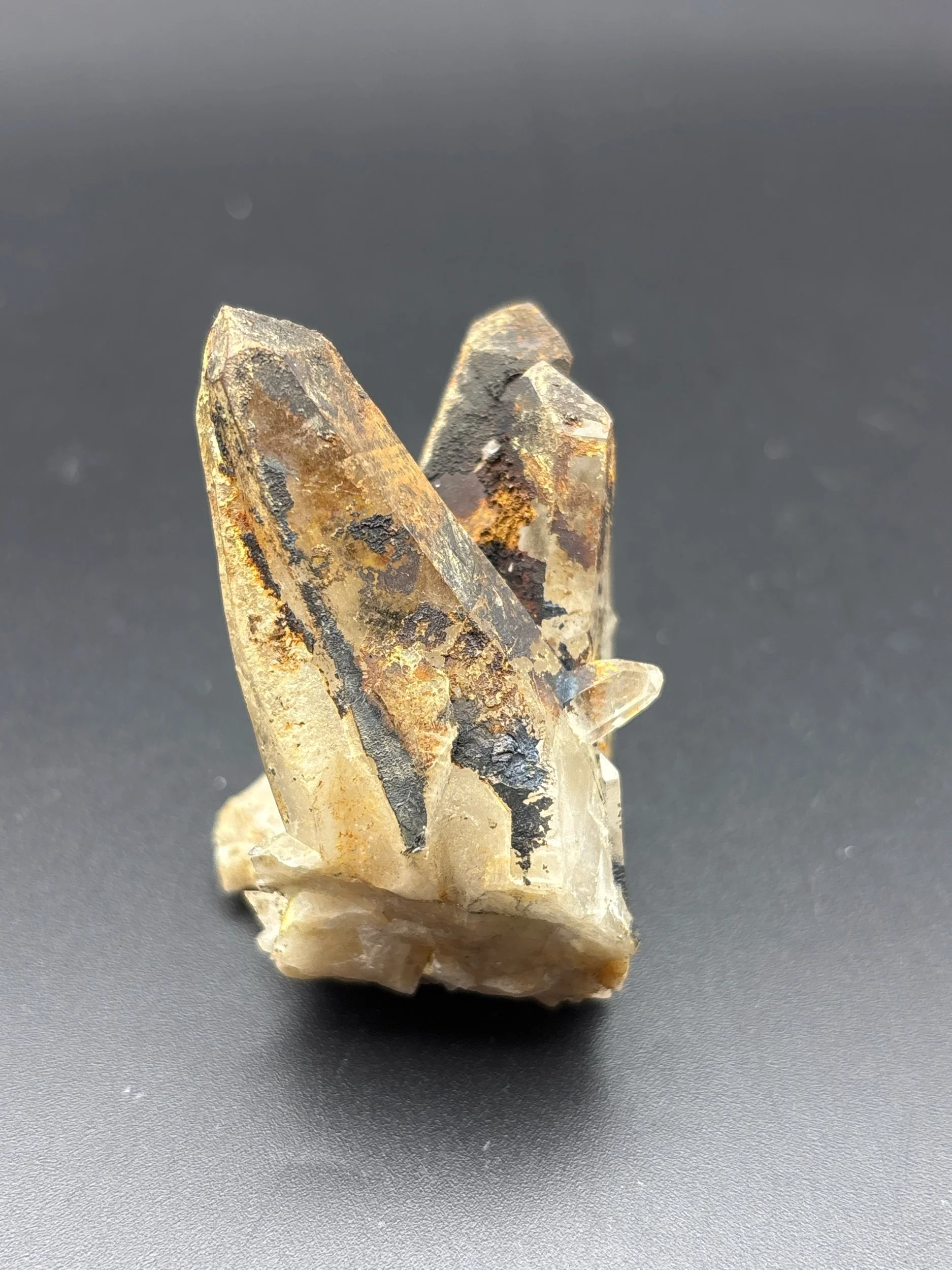
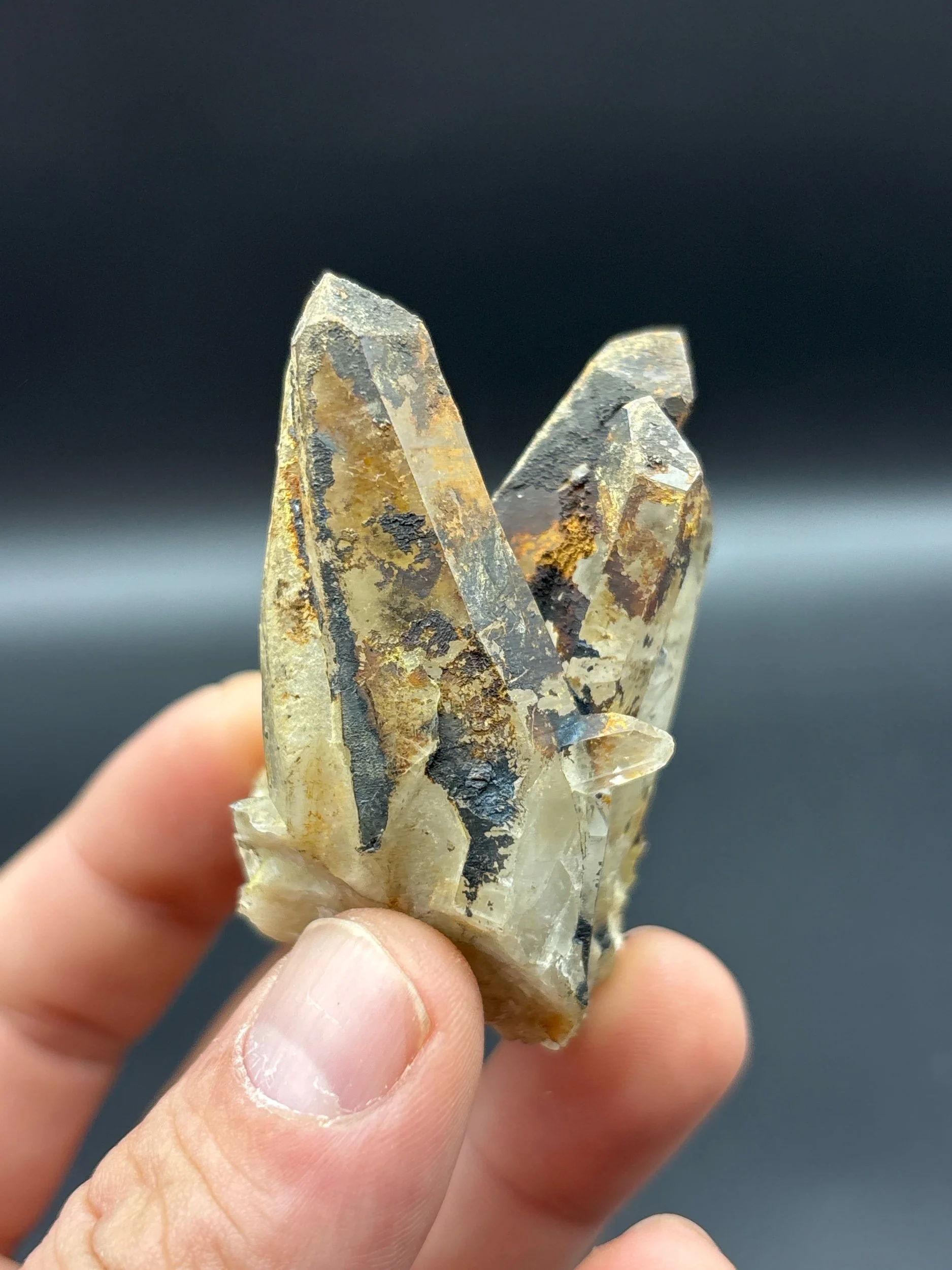


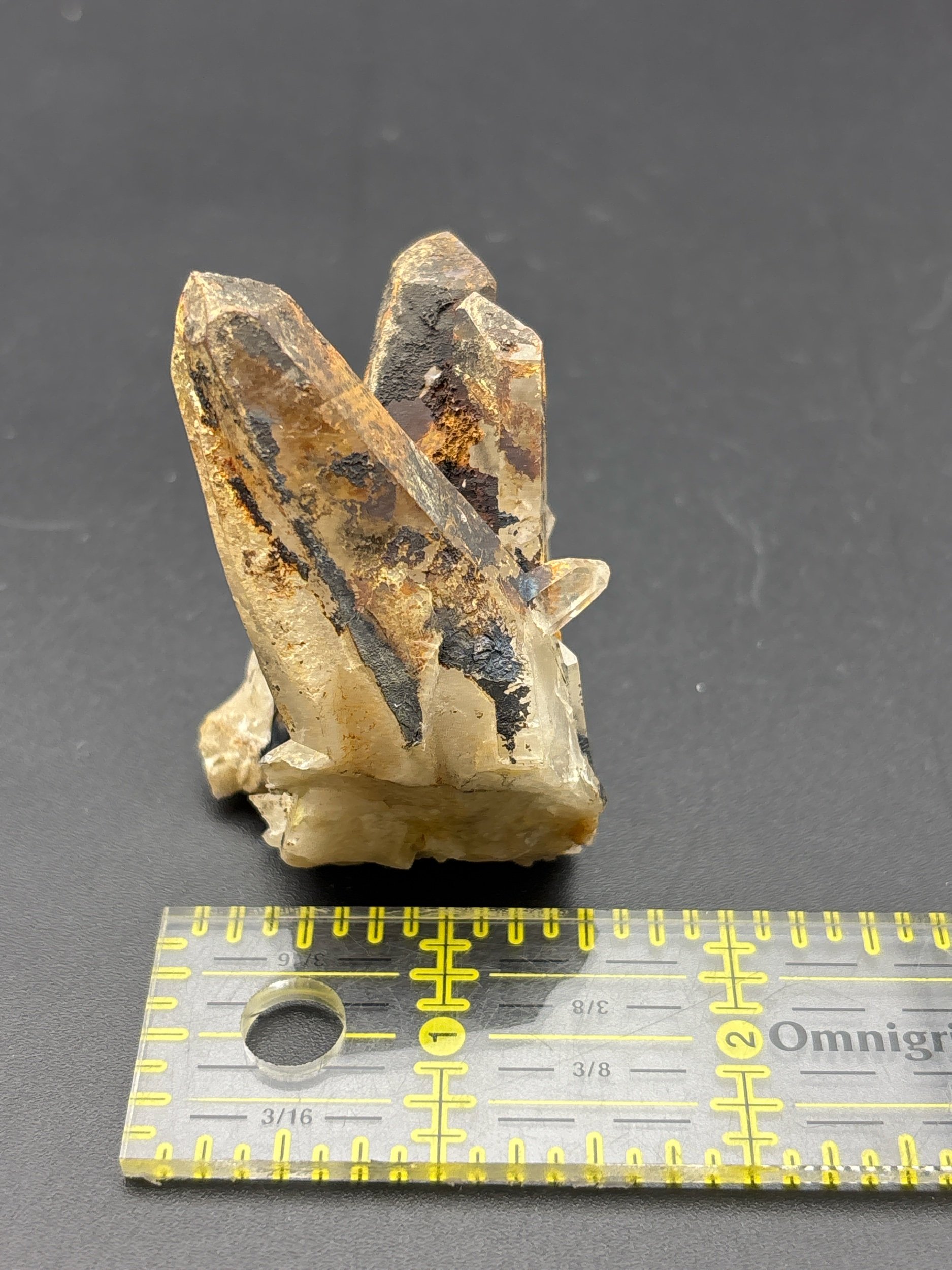
The Black Pine Mine was an industrial polymetallic deposit hosted in Missoula quartzite and spokane shale. The mine had an operational history older than Montana’s statehood, first discovered in 1882, with a rocky ownership to follow. It changed hands and operations several times before its final shutdown in 2018. Professional specimen collecting only occurred during a short window in the 80s, under contract agreement with Inspiration Copper and Duane Johnson. The site now lies on private state land and is an active DEQ cleanup site.
Complex mineral assemblages were present in the Black Pine. Heavily oxidized veins hosted a vast array of copper, zinc, and iron minerals, among others. Primary metallics were tetrahedrite, pyrite, hubnerite, sphalerite, and galena. Through oxidation, some of the most unique combinations and examples in the world were produced, including 3 type locality species and the largest examples of veszelyite in the world.
This is a small but superb example of iron dominant oxides partially coating a cluster of quartz crystals, one of which displays offset japan-law twinning. The specimen sets and displays quite well naturally, creating a focal view of the law twin. Offset law twins are among the most common in the Black Pine. This is a classic example
Thank you so much for viewing! Please message for any further information
(2.3 × 1.6 × 1.4 in - 5.8 × 4.0 × 3.5 cm) 2.6oz / 73g
ORDERS SHIP MONDAYS
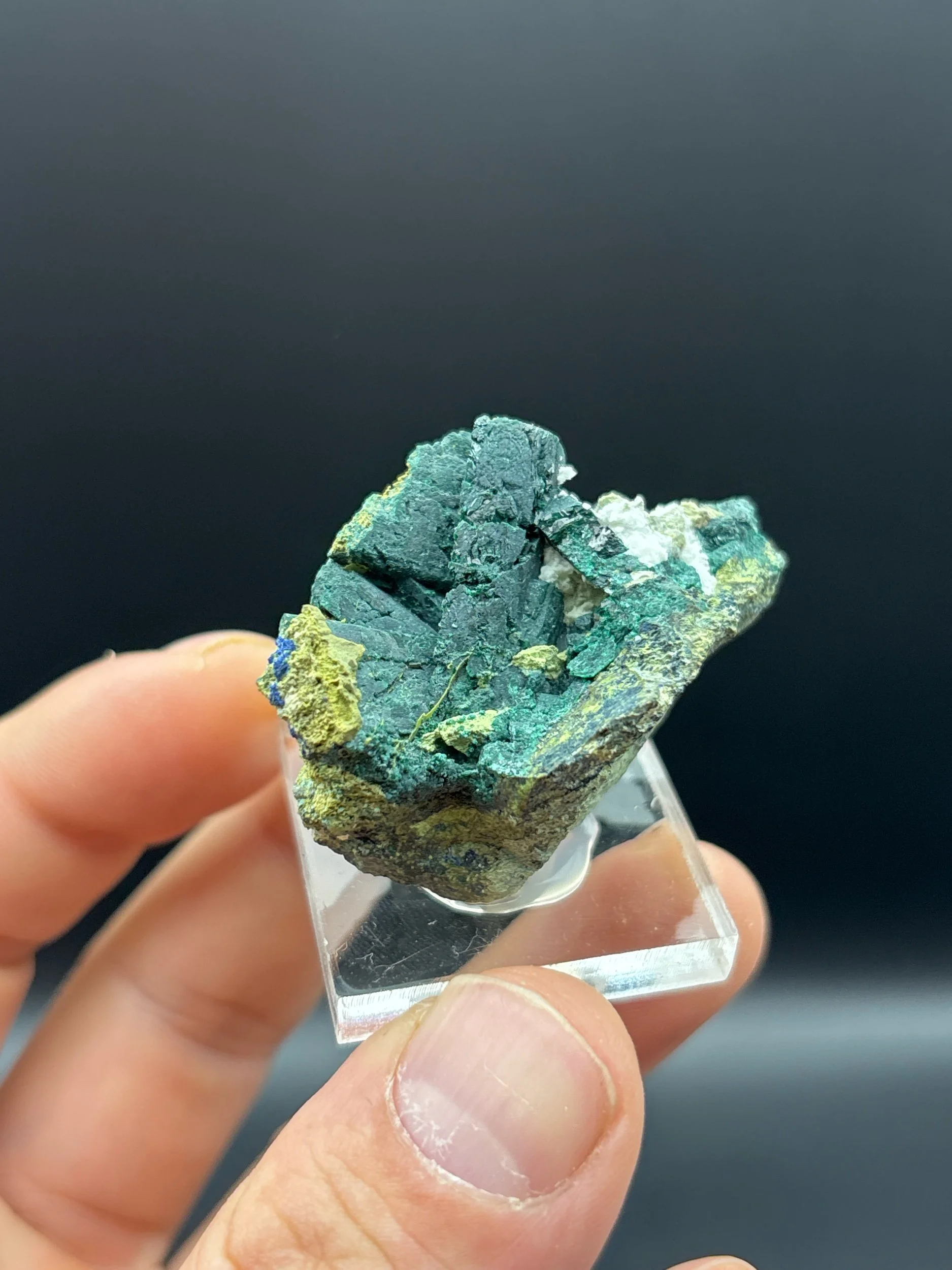
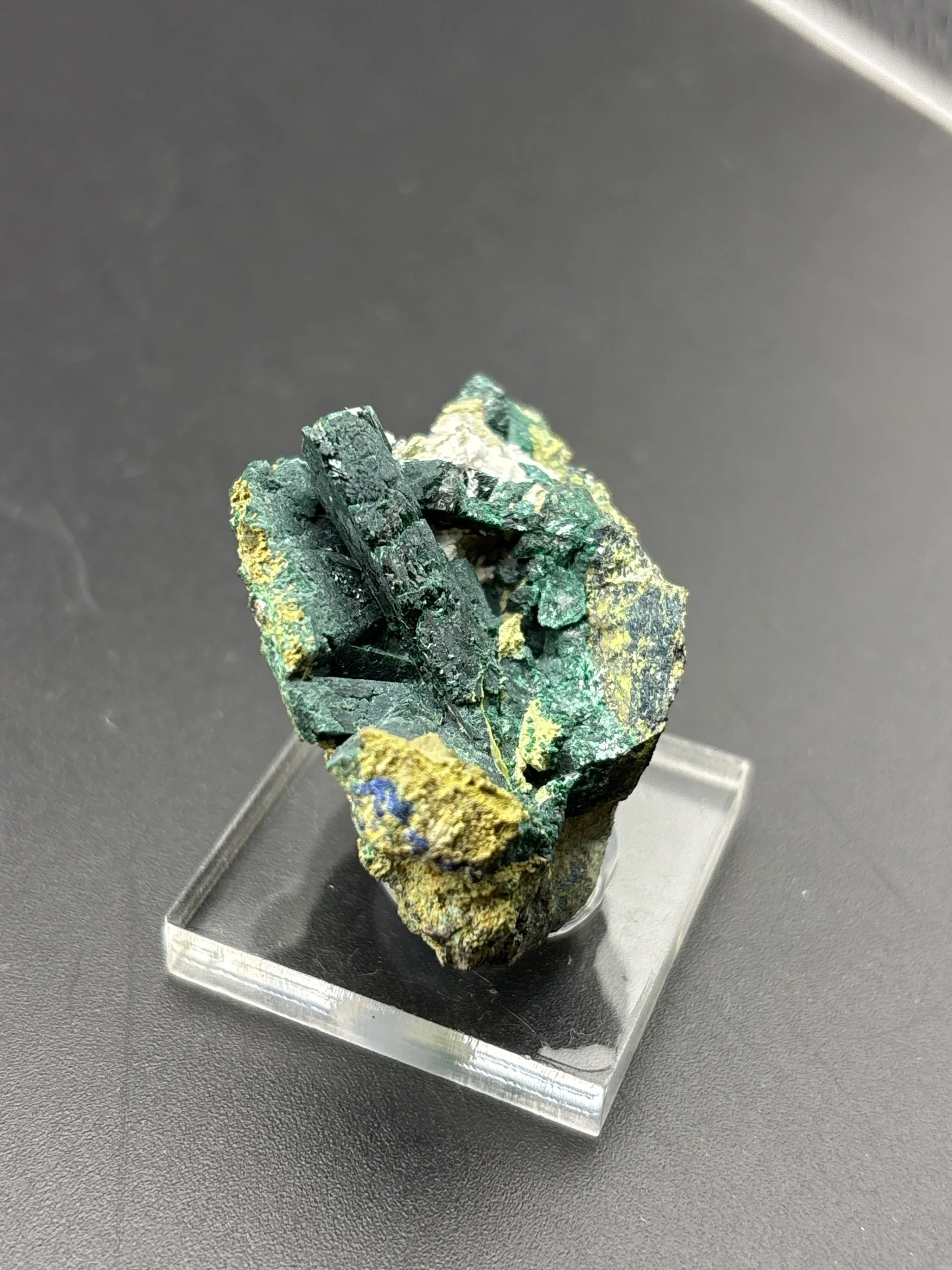
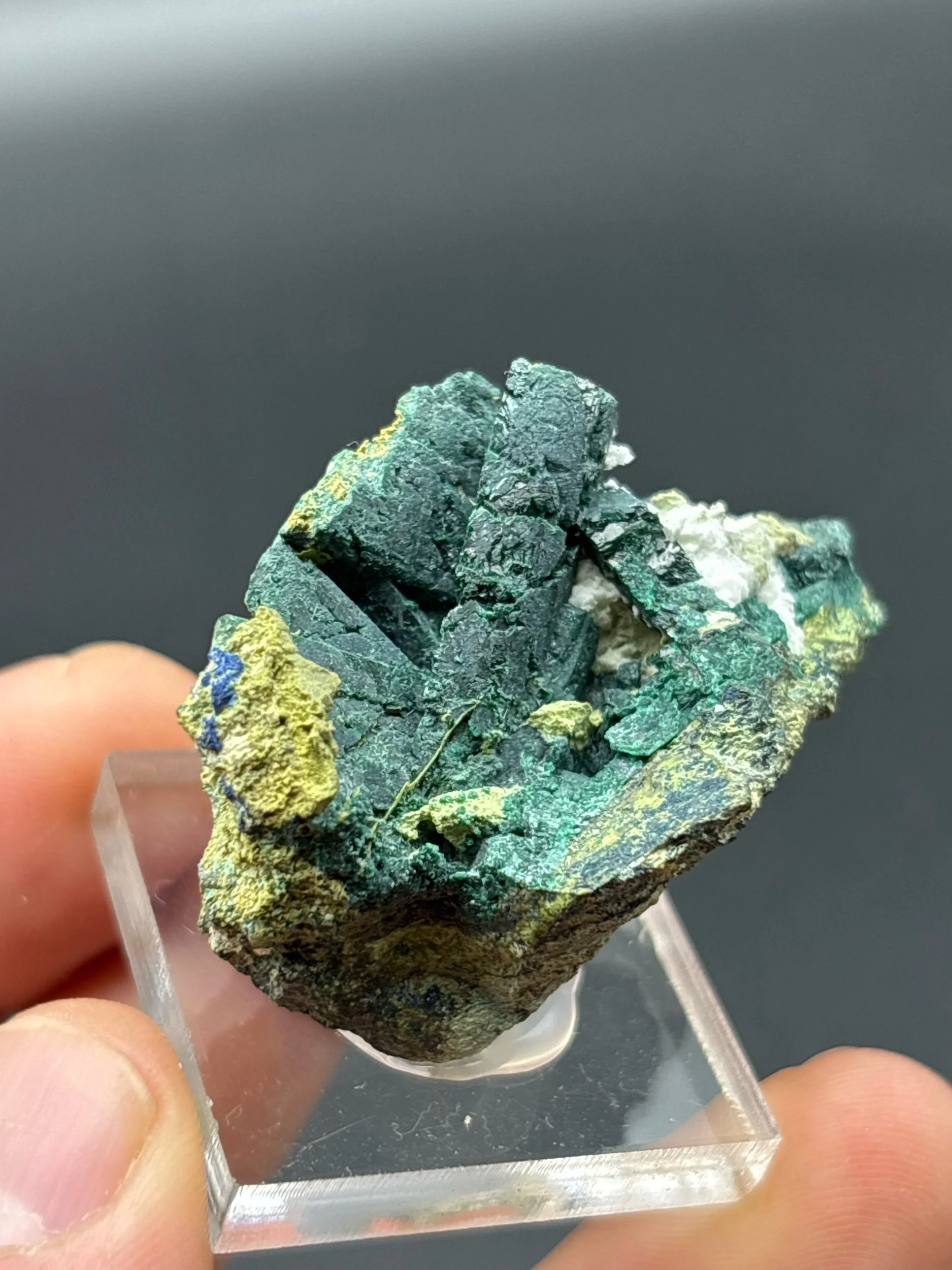


The Tsumeb mine is regarded in the mineral collecting world by many as the greatest locality overall. Including a wide range of species, rich history, and type locale specimens, the depth of collectability often goes far beyond the visual appeal. The mine was first discovered on January 21, 1893, by Matthew Rogers. It was initially described as “The Green Hill”. The mine would operate for just over a century, shutting down in 1996 for economic reasons. Tsumeb is considered a world-class quality producer of Adamite, Azurite, Cerussite, Dioptase, Mimetite, Tennantite, and many other species. It is home to 76 Type Locality Minerals.
This is an absolutely classic example of malachite pseudomorphing azurite with bayldonite association, from the world renowned Tsumeb Mine. A focal crystal presents itself centralized in the matrix with aesthetics. Mounted to an acrylic base.
Thank you so much for viewing! Please message for any further information
(1.7 × 1.1 × 1.2 in - 4.3 × 2.7 × 3.0 cm) 1.6oz / 45g
ORDERS SHIP MONDAYS
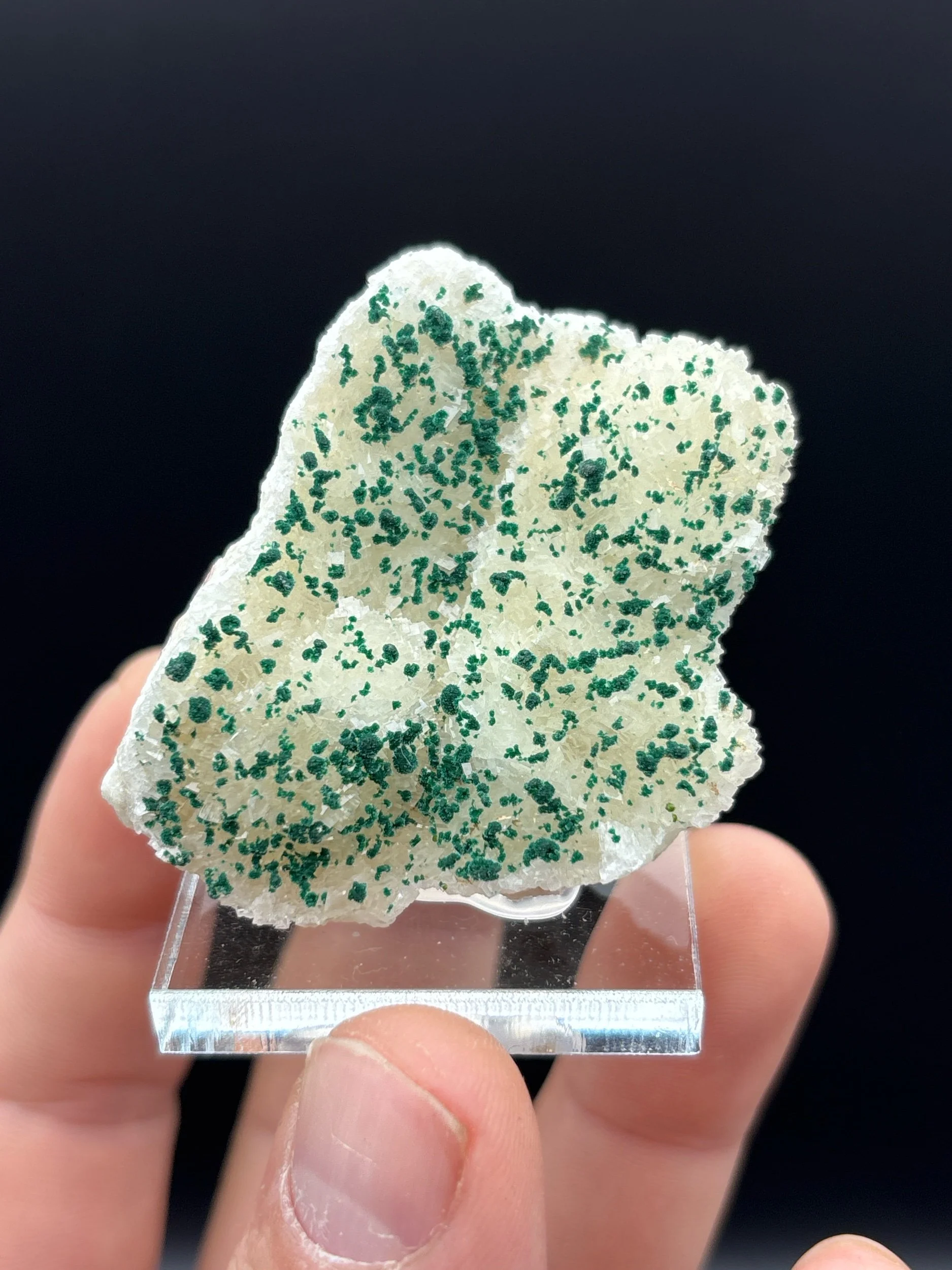

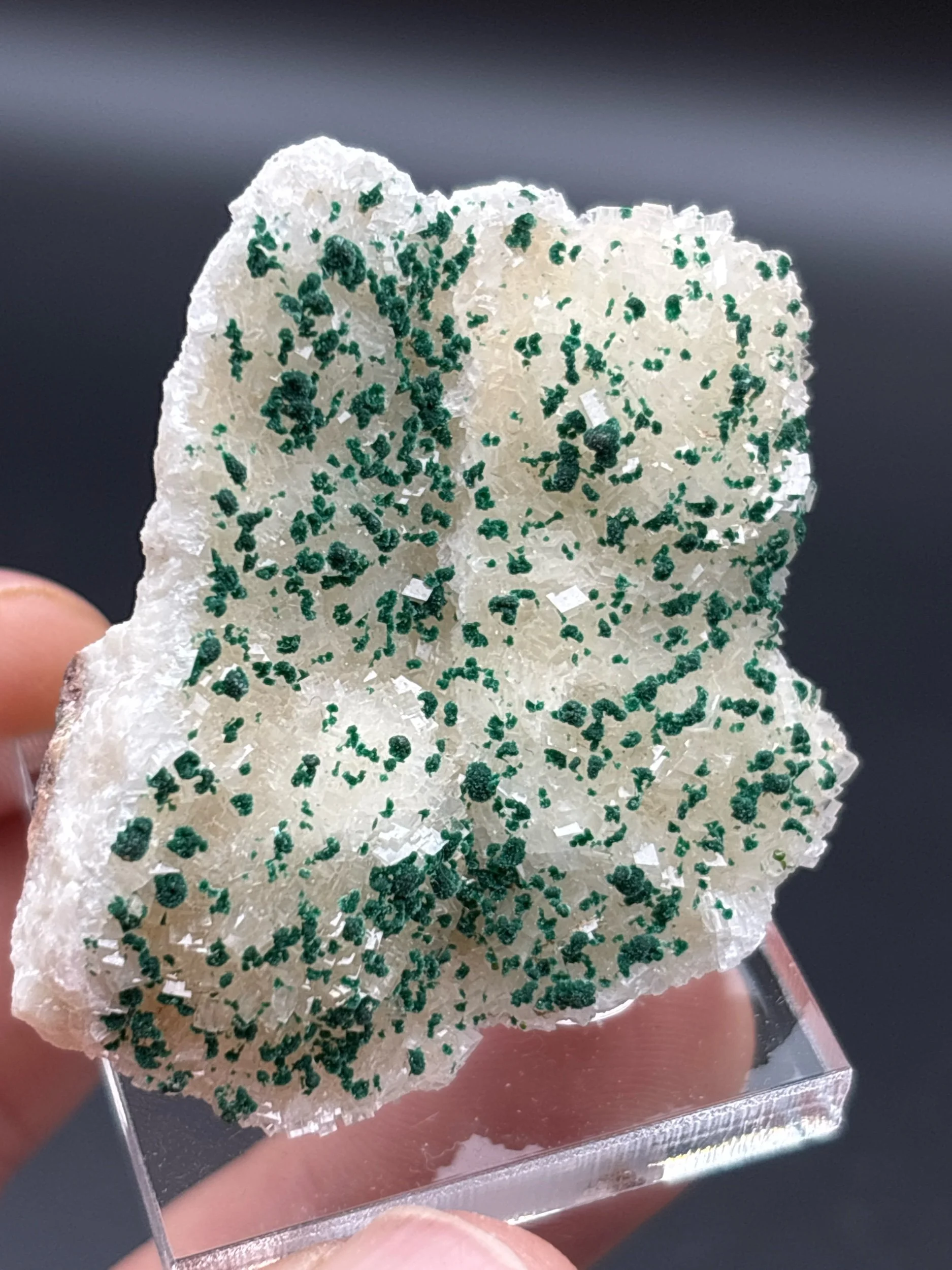

The Tsumeb mine is regarded in the mineral collecting world by many as the greatest locality overall. Including a wide range of species, rich history, and type locale specimens, the depth of collectability often goes far beyond the visual appeal. The mine was first discovered on January 21, 1893, by Matthew Rogers. It was initially described as “The Green Hill”. The mine would operate for just over a century, shutting down in 1996 for economic reasons. Tsumeb is considered a world-class quality producer of Adamite, Azurite, Cerussite, Dioptase, Mimetite, Tennantite, and many other species. It is home to 76 Type Locality Minerals.
A rich and beautiful cluster of malachite coating white dolomite! The contrast of this specimen is remarkable and striking. The dolomite crystals while small, are extremely sharp and gemmy where crystallography is present. Mounted to an acrylic base and accompanied by dealer label from Persson Rare Minerals noting origin of Burton Ford collection
Thank you so much for viewing! Please message for any further information
(1.8 × 2.0 × 0.6 in - 4.5 × 5.0 × 1.5 cm) 1.9oz / 53g (with base)
ORDERS SHIP MONDAYS


Initially discovered in 1887, the Summit Mine lies in the Radersburg district in the southern part of Broadwater County. The finest hemimorphite in the USA come from this locality, as well as numerous other interesting and uncommon minerals. The mine has been inactive for some time and lies on private property.
This is a classic example of Mottramite on descloizite matrix. Only occuring at depth in one area of the mine, this material is quite rare indeed. Accompanied by the label of Chris Tucker. Chris is undoubtedly the collector of the specimen, as he wrote several articles on the mine as well as is known to have collected there.
Thank you so much for viewing! Please message for any further information
(2.7 × 1.6 × 1.0 in - 6.8 × 4.0 × 2.5 cm) 2.8oz / 78g
ORDERS SHIP MONDAYS


The many mines of Butte amount to over 11,000 miles of workings below the city. Without specific provenance, it’s nearly impossible to associate specimens with specific mines. The “richest hill on earth” first originated as a mining camp for gold but would later rapidly develop into one of the world’s most historic sulfide deposits. Rich veins of covellite, chalcocite, enargite, and other minerals as thick as 100 feet were stoped out, supplying the world with a large portion of its industrial copper.
This is a fairly simple, yet elegant example of pyrite with a light tarnish to the surface. The tarnish gives a blue color, which accents the gold of the pyrite quite uniquely. From the deep Butte mines, this piece represents rich history in the mining world.
Thank you so much for viewing! Please message for any further information
(2.0 × 1.2 × 1.0 in - 5.0 × 3.0 × 2.5 cm) 3.1oz / 87g
ORDERS SHIP MONDAYS


First claimed in 1959 by Emil Chiline and George Richardson, Crystal Park has a long standing history of being one of Montana’s most known locations. In 1993, it would become a fee recreation site administered by the Forest Service. Smoky quartz, amethyst, scepters, and (rarely) Japan law twin quartz can be found. The site is a hydrothermal breccia in the granite of the Pioneer Mountain range, part of the Pioneer Batholith.
This crystal comes from the estate of Bud Erhle, in a flat labeled “1970s Crystal Park”. The crystal in question is a remarkably nice amethyst scepter form, with excellent color. Quality like this is uncommon from crystal park, especially in the modern era of collecting. There is a small ding on the tip, as most tend to have. The specimen is non permanently mounted to an acrylic base.
Thank you so much for viewing! Please message for any further information
(1.8 × 1.0 × 1.2 in - 4.5 × 2.5 × 9.6 cm) 2.0oz / 55g (with base)
ORDERS SHIP MONDAYS


The Black Pine Mine was an industrial polymetallic deposit hosted in Missoula quartzite and spokane shale. The mine had an operational history older than Montana’s statehood, first discovered in 1882, with a rocky ownership to follow. It changed hands and operations several times before its final shutdown in 2018. Professional specimen collecting only occurred during a short window in the 80s, under contract agreement with Inspiration Copper and Duane Johnson. The site now lies on private state land and is an active DEQ cleanup site.
Complex mineral assemblages were present in the Black Pine. Heavily oxidized veins hosted a vast array of copper, zinc, and iron minerals, among others. Primary metallics were tetrahedrite, pyrite, hubnerite, sphalerite, and galena. Through oxidation, some of the most unique combinations and examples in the world were produced, including 3 type locality species and the largest examples of veszelyite in the world.
This is a small but superb example of iron dominant oxides coating a plate of quartz crystals. Micro crystals of beudantite are present with jarosite, hematite, and heavy goethite. A lesser seen example, as the copper oxides tend to dominate the environment.
Thank you so much for viewing! Please message for any further information
(2.6 × 1.6 × 0.9 in - 6.6 × 4.0 × 2.2 cm) 2.0oz / 57g
ORDERS SHIP MONDAYS


A famous find in the 1970s by the late Bud Erhle, the signature calcite “fingers" of Carter County have long been a sought-after classic for collectors. Formed in concretion in the Pierre and bear paw shale, there are actually apparently several locales for the material. The crystal forms are often coated in a thick late-stage crust that is only removed by vinegar etching. Baryte, and selenite are known to form as well in the same concretions, which on occasion have fossils.
This is a classic miniature example of the historic and classic calcite “fingers” from Carter County. No damage is present to the crystal. This piece has been treated at some point with vinegar to remove the crusts. Non permanently mounted to acrylic.
Thank you so much for viewing! Please message for any further information
(2.0 × 0.2 × 0.2 in - 5.0 × 0.5 × 0.5 cm) 0.5oz / 15g (with base)
ORDERS SHIP MONDAYS


A famous find in the 1970s by the late Bud Erhle, the signature calcite “fingers" of Carter County have long been a sought-after classic for collectors. Formed in concretion in the Pierre and bear paw shale, there are actually apparently several locales for the material. The crystal forms are often coated in a thick late-stage crust that is only removed by vinegar etching. Baryte, and selenite are known to form as well in the same concretions, which on occasion have fossils.
This is a classic miniature example of the historic and classic calcite “fingers” from Carter County. No damage is present to the crystal. the crusts are still present, indicating this piece to be natural entirely and not vinegar treated, truly a rarity. Non permanently mounted to acrylic.
Thank you so much for viewing! Please message for any further information
(1.7 × 0.9 × 0.8 in - 4.3 × 2.2 × 2.0 cm) 0.8oz / 22g (with base)
ORDERS SHIP MONDAYS


The Holcim Quarry in Lockport, New York, is a well-known collecting site developed in Silurian-aged dolostone of the Niagara Escarpment. It has produced a wide range of mineral specimens, most notably well-formed dolomite crystals along with calcite, fluorite, sphalerite, and occasional galena. Many of these minerals occur lining vugs and fractures, often showing sharp crystal form and attractive color contrasts. Access has been limited in recent years, but material from the quarry remains widely represented in both private and museum collections.
This specimen is a classic miniature example of dolostone matrix hosting small yellow sphalerite crystals. the crystals are extremely fluorescent orange under long wave(365nm) light. This attractive specimen displays naturally quite well and is a wonderful example of historic New York locales. Accompanied by an older generic label.
Thank you so much for viewing! Please message for any further information
(2.3 × 2.1 × 1.5 in - 5.8 × 5.3 × 3.8 cm) 3.2oz / 88g
ORDERS SHIP MONDAYS


The Black Pine Mine was an industrial polymetallic deposit hosted in Missoula quartzite and spokane shale. The mine had an operational history older than Montana’s statehood, first discovered in 1882, with a rocky ownership to follow. It changed hands and operations several times before its final shutdown in 2018. Professional specimen collecting only occurred during a short window in the 80s, under contract agreement with Inspiration Copper and Duane Johnson. The site now lies on private state land and is an active DEQ cleanup site.
Complex mineral assemblages were present in the Black Pine. Heavily oxidized veins hosted a vast array of copper, zinc, and iron minerals, among others. Primary metallics were tetrahedrite, pyrite, hubnerite, sphalerite, and galena. Through oxidation, some of the most unique combinations and examples in the world were produced, including 3 type locality species and the largest examples of veszelyite in the world.
This is a small but superb example of copper dominant oxides coating a plate of brecciated quartz. Hailing from the Tim Smith Vein, specifically, “Pocket C” in 8/16/1986 by Duane Johnson under contract. This specimen is a rich assemblage, and depicts the complex minerology classic to the locale. Expect small fragments to shed from the matrix periphery if improperly handled. This is a rare opportunity at a Montana classic.
Thank you so much for viewing! Please message for any further information
(2.7 × 2.2 × 1.1 in - 6.8 × 5.8 × 2.8 cm) 3.5oz / 99g
ORDERS SHIP MONDAYS


The Black Pine Mine was an industrial polymetallic deposit hosted in Missoula quartzite and spokane shale. The mine had an operational history older than Montana’s statehood, first discovered in 1882, with a rocky ownership to follow. It changed hands and operations several times before its final shutdown in 2018. Professional specimen collecting only occurred during a short window in the 80s, under contract agreement with Inspiration Copper and Duane Johnson. The site now lies on private state land and is an active DEQ cleanup site.
Complex mineral assemblages were present in the Black Pine. Heavily oxidized veins hosted a vast array of copper, zinc, and iron minerals, among others. Primary metallics were tetrahedrite, pyrite, hubnerite, sphalerite, and galena. Through oxidation, some of the most unique combinations and examples in the world were produced, including 3 type locality species and the largest examples of veszelyite in the world.
This is a small but superb example of iron dominant oxides coating a plate of quartz. Micro crystals of beudantite are present with jarosite, hematite, and heavy goethite. A lesser seen example, as the copper oxides tend to dominate the environment.
Thank you so much for viewing! Please message for any further information
(2.8 × 1.9 × 1.1 in - 7.1 × 4.8 × 2.8 cm) 3.3oz / 93g
ORDERS SHIP MONDAYS


The Tsumeb mine is regarded in the mineral collecting world by many as the greatest locality overall. Including a wide range of species, rich history, and type locale specimens, the depth of collectability often goes far beyond the visual appeal. The mine was first discovered on January 21, 1893, by Matthew Rogers. It was initially described as “The Green Hill”. The mine would operate for just over a century, shutting down in 1996 for economic reasons. Tsumeb is considered a world-class quality producer of Adamite, Azurite, Cerussite, Dioptase, Mimetite, Tennantite, and many other species. It is home to 76 Type Locality Minerals.
A rich and beautiful cluster of large mimetite crystals! This specimen is significant for the species, and locality. Accompanied by the labels of Christopher O’Neill, Lawrence Conklin, and Mineral Kingdom of Woodmere (Zweibels), this piece dates back to the 70s, when it was sold for 300 dollars then, based on the cards! A special piece for any collector, especially the Tsumeb afficianado.
Thank you so much for viewing! Please message for any further information
(1.5 × 1.5 × 0.9 in - 3.8 × 3.8 × 2.2 cm) 1.2oz / 34g
ORDERS SHIP MONDAYS


Mineral specimens from the Pack Rat Mine in Montana became known primarily through small-scale collecting rather than large commercial production. Early miners occasionally saved attractive pieces of crystallized minerals encountered while following the ore veins, and some of these specimens later entered private collections. Interest from mineral collectors increased during the mid-twentieth century as reports of well-formed crystals and unusual mineral associations circulated among hobbyists and dealers. Because the workings were relatively small, most specimens recovered from the mine were limited in number and often obtained directly from underground pockets or from material on nearby dumps. A portion of the better examples gradually found their way into mineral shows, museum collections, and the hands of regional collectors. Today, specimens attributed to the Pack Rat Mine are considered relatively uncommon and are usually associated with material recovered during earlier periods of mining and collecting. While the mine is actively held as claim, no known current specimen production exists.
This specimen is a classic plate of baryte, crystals showing on all sides of the specimen. A late-stage crust encases some of the crystals but overall, visual appeal is great. Rich honey brown color. Accompanied by a handwritten label by Chuck Borland, and the label of Tom and Judy Tucker.
Thank you so much for viewing! Please message for any further information
(3.1 × 1.9 × 1.0 in - 7.8 × 4.8 × 2.2 cm) 3.9oz / 110g
Orders ship Mondays


Berg Aukas is a historic mineral deposit located in northern Namibia, about 40 km south of the town of Grootfontein. Geologically, the deposit is a hydrothermal lead-zinc-vanadium ore body hosted in dolostone of the Neoproterozoic Otavi Group. Mineralization formed when metal-rich fluids moved through fractures and dissolution cavities in the carbonate rocks, depositing sulfide minerals such as galena and sphalerite along with unusual secondary minerals. The mine is especially famous for producing rare vanadium minerals, including the bright red lead vanadate descloizite and other colorful oxidation-zone species that formed when the ore was exposed to weathering.
Mining at Berg Aukas began in 1913 and expanded significantly during the mid-1900s, eventually becoming one of the world’s most important sources of vanadium-bearing minerals. Although commercial mining ceased in 1978, Berg Aukas remains well known among geologists and mineral collectors for its exceptional mineral diversity and specimen quality.
This specimen is a plate of fairly large descloizite crystals clustered together across the matrix. Carrying with it a Colorado Geologic Industries label, which dates between the 1960s and 1980s when the company was actively dealing. The specimen does have some broken crystals unfortunately. Largely, the display area is in good condition, however.
Thank you so much for viewing! Please message for any further information
(3.5 × 3.1 × 2.1 in - 8.9 × 7.8 × 5.3 cm) 10.5oz / 299g
Orders ship Mondays


The Morenci Mine in Arizona is one of the largest copper mines in North America, known not only for its immense copper output but also for producing exceptional mineral specimens. Over the decades, it has yielded fine examples of azurite, malachite, chrysocolla, and rarely dioptase or turquoise, often noted for their vivid colors and intricate crystal formations. Collectors particularly prize its well-formed azurite crystals and striking pseudomorphs of malachite after azurite. Although large-scale commercial mining dominates the site today, Morenci remains an important locality in mineralogy for its diverse and historically significant specimen production.
This specimen features a matrix coated in pale blue chrysocolla, accented by electric green micro crystals of dioptase! An excellent locale example, this comes from the N.A. Wintringham Collection, via Excalibur Mineral Company. An American classic!
Thank you so much for viewing! Please message for any further information
(3.6 × 1.8 × 1.0 in - 9.3 × 4.5 × 2.5 cm) 4.0oz / 114g
Orders ship Mondays
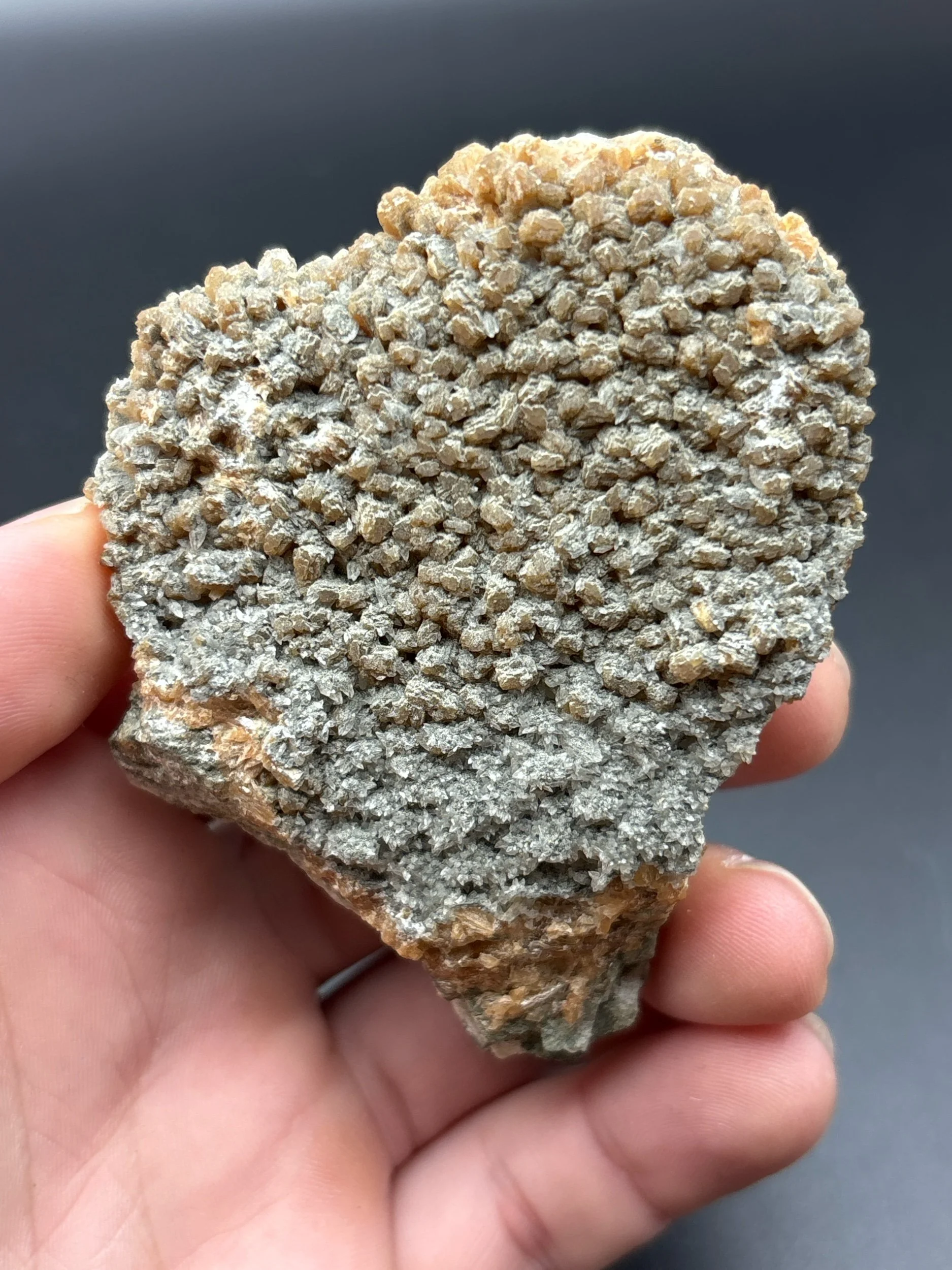
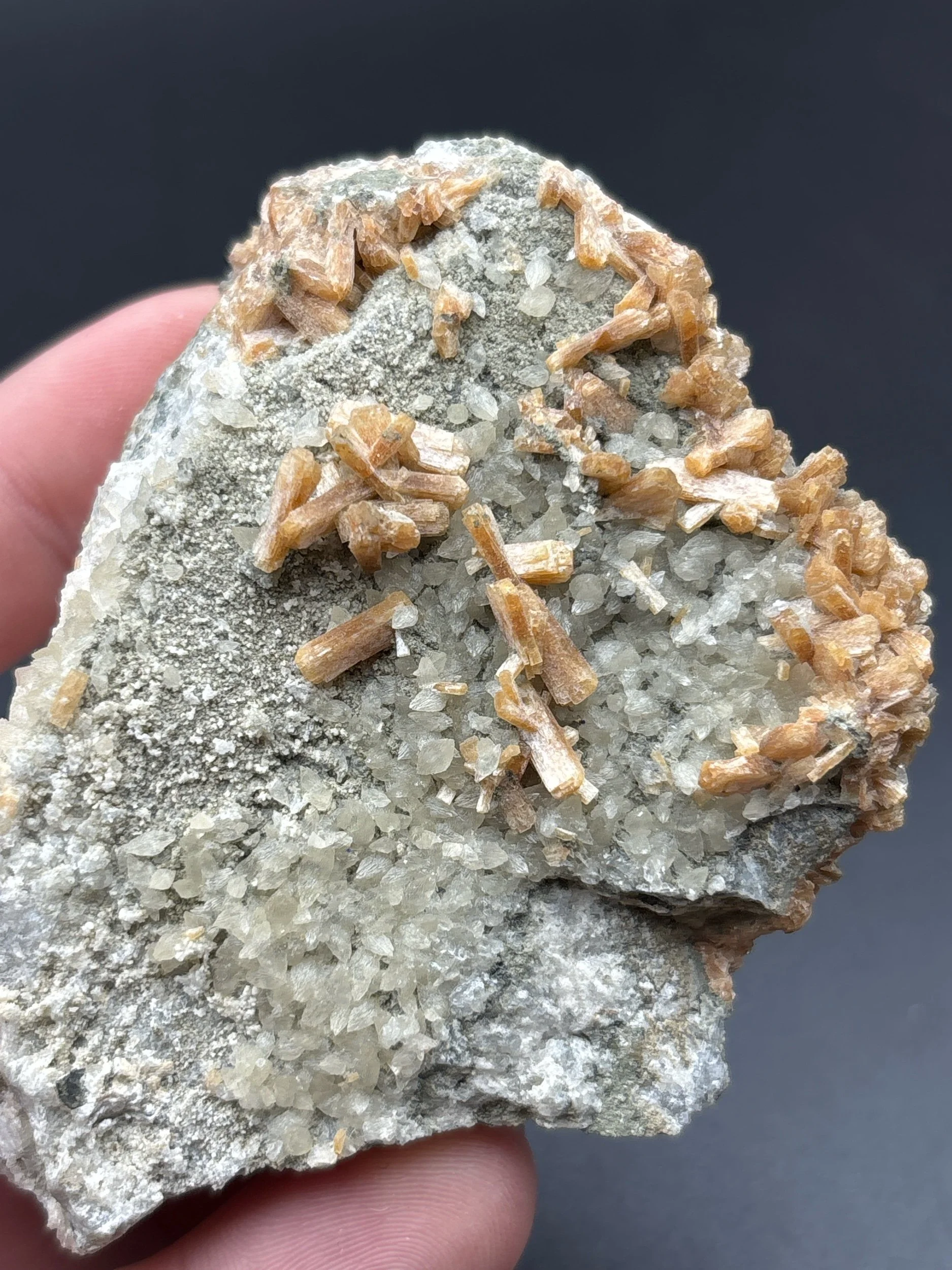
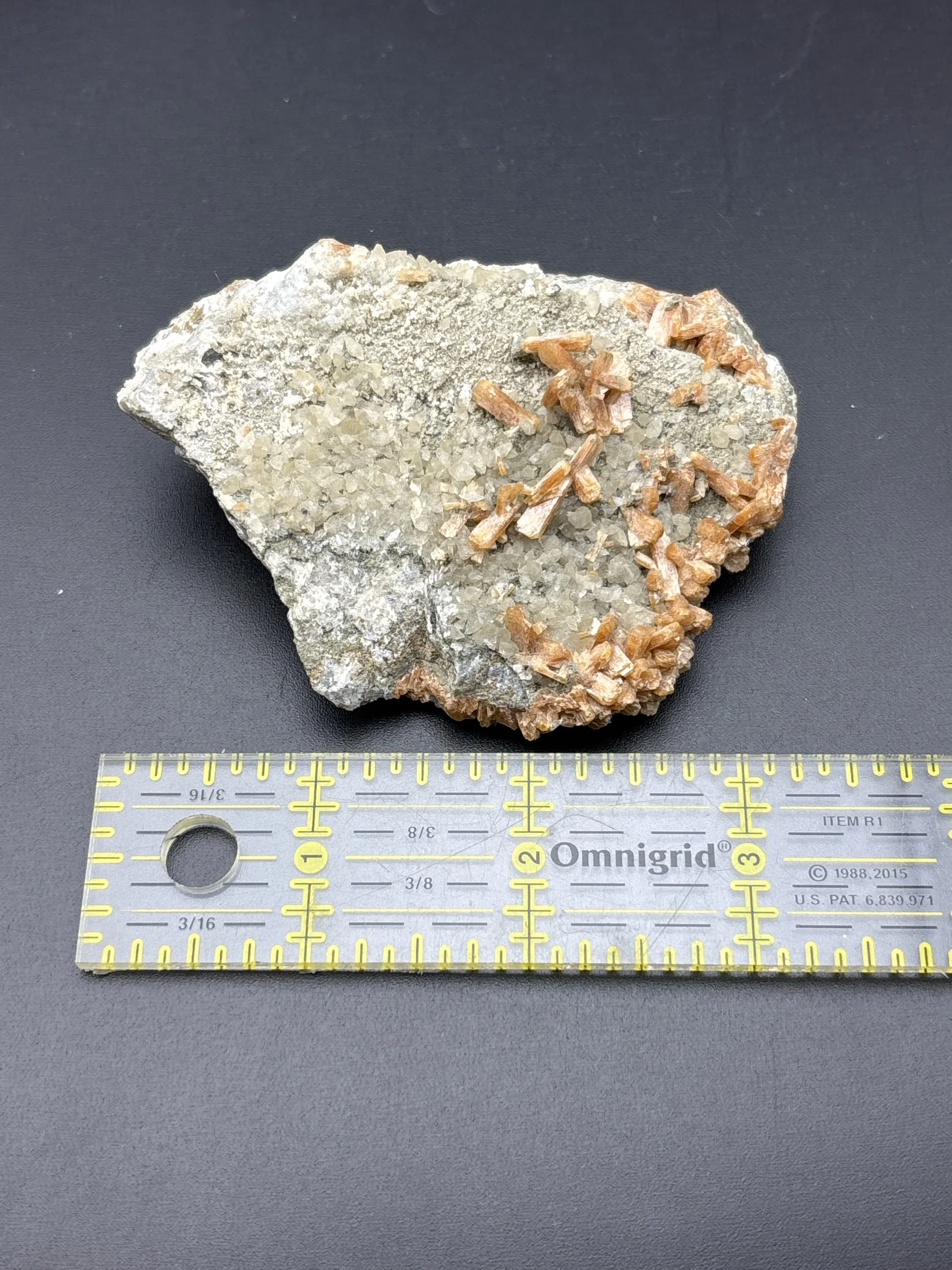
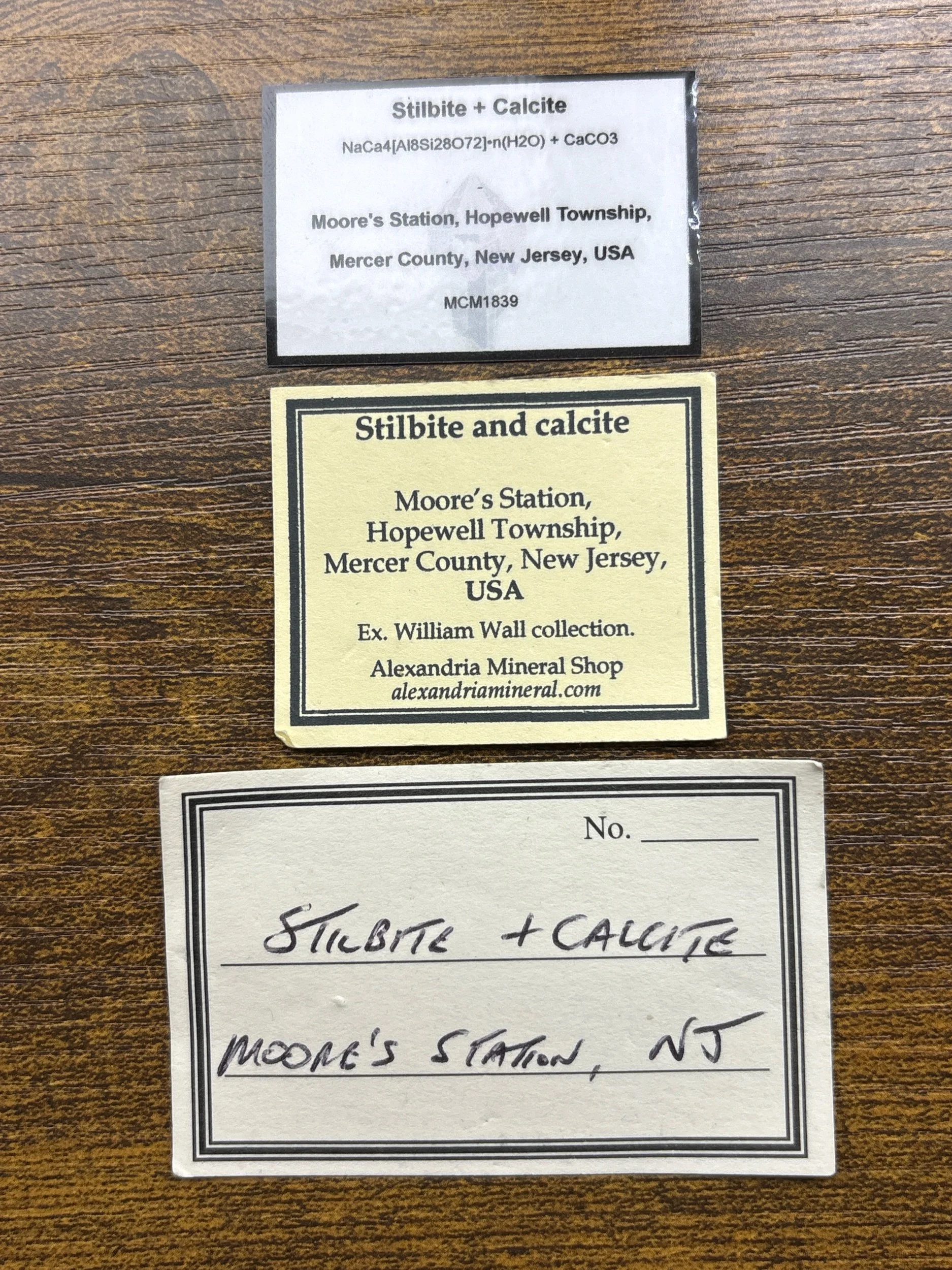
Via Mindat:
“This is a very old locality (circa 1897) at the Moore's Station (no longer exists) of the Reading RR. Specimens are found only in old collections.
The mineral listed for Moore’s Station indicate that the locality is in trap rock. The site of the former Moore’s Station, on the Reading (Conrail) Railroad is in an area underlain by the sediments of the Passaic formation. The quarry that is the probable locality is located approximately 1 mile north along the railroad from the former station site and ½ mile north of the Hopewell barite mine. It is also approximately 1 mile west of the intersection of Rt. 518 and Rt. 518 spur near the western end of Hopewell boro. The coordinates given are for the quarry, not the former station.
Here, just off the railroad tracks to the east is a small, shallow quarry that was opened in the 19th century and has been abandoned for many years. It is marked on a topographic map of the “Vicinity of Flemington”, dated 1887. The quarry is located in the diabase dike that extends from the western end of the Rocky Hill Sill, cuts upward through the Passaic Formation and is cut off by the Hopewell Fault, a major intrabasin fracture. Proximity of the quarry to this fault may explain why a significant number of mineral specimens were preserved from such a small excavation.
There is longstanding confusion between this locality and “Moore” a site along Rt. 29, very near the Delaware River and the northwestern end of Baldpate Mountain, approximately 3.7 airline miles west – southwest of the Moore’s Station on the Reading (Conrail) Railroad. The 1887 map, cited above, calls the place near the river “Moores”. The USGS topographic map calls it “Moore” but the road map published by Hagstrom calls it Moore’s Station. Trap Rock Industries refers to their large adjacent quarry in the northwest end of Baldpate Mountain as the Moore’s Station Quarry. The TRI quarry, reactivated it in 1982 after 50 years of dormancy, is also cut by splays from the Hopewell Fault and has produced mineral specimens. It was apparently not yet active at the time the 1887 map was published. Because of antiquity of the specimens and the confusion over the name the actual source of any specimen labeled “Moore’s Station” needs to be given some additional scrutiny.” (Moore's Station, Hopewell Township, Mercer County, New Jersey, USA)
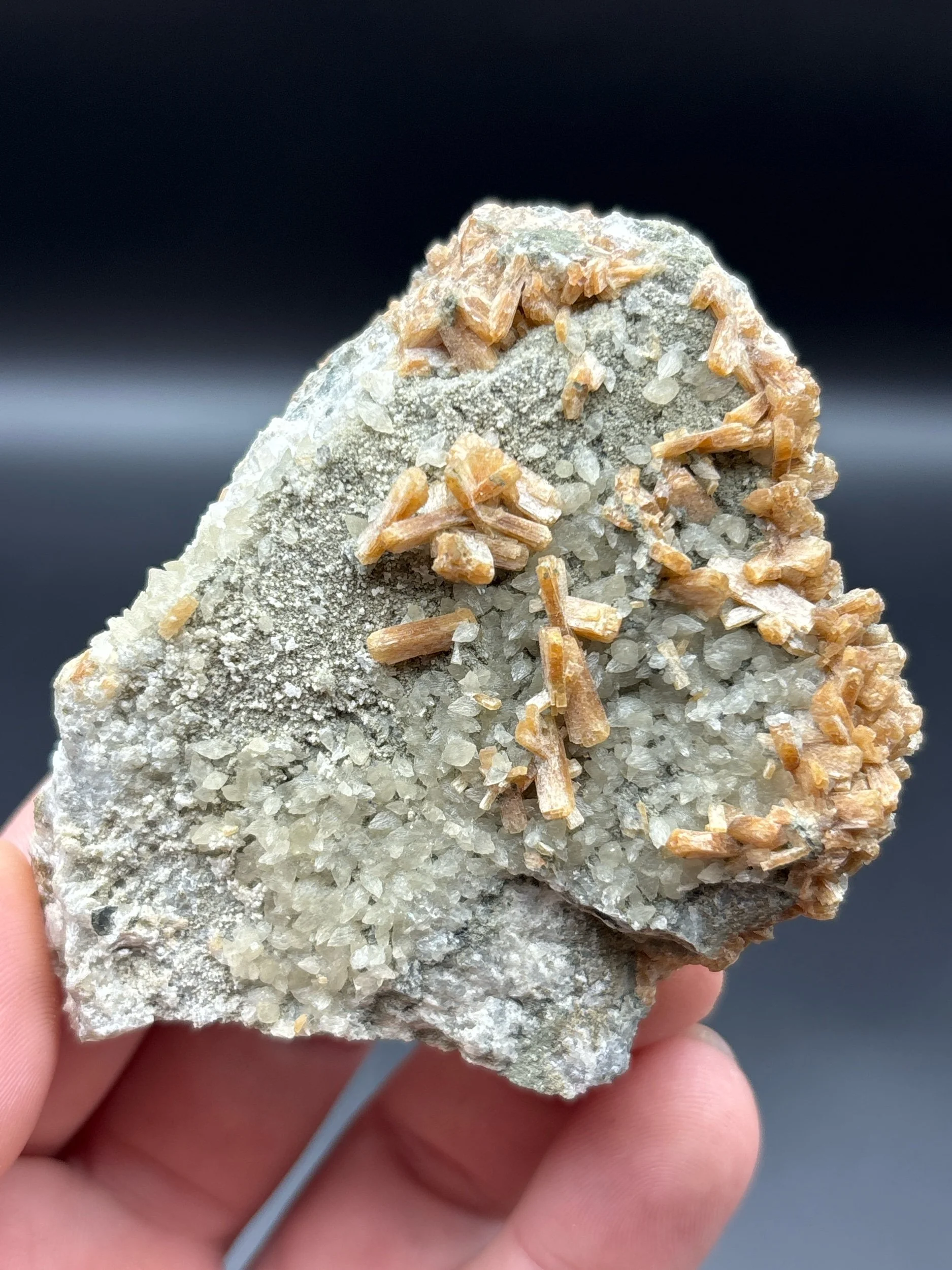
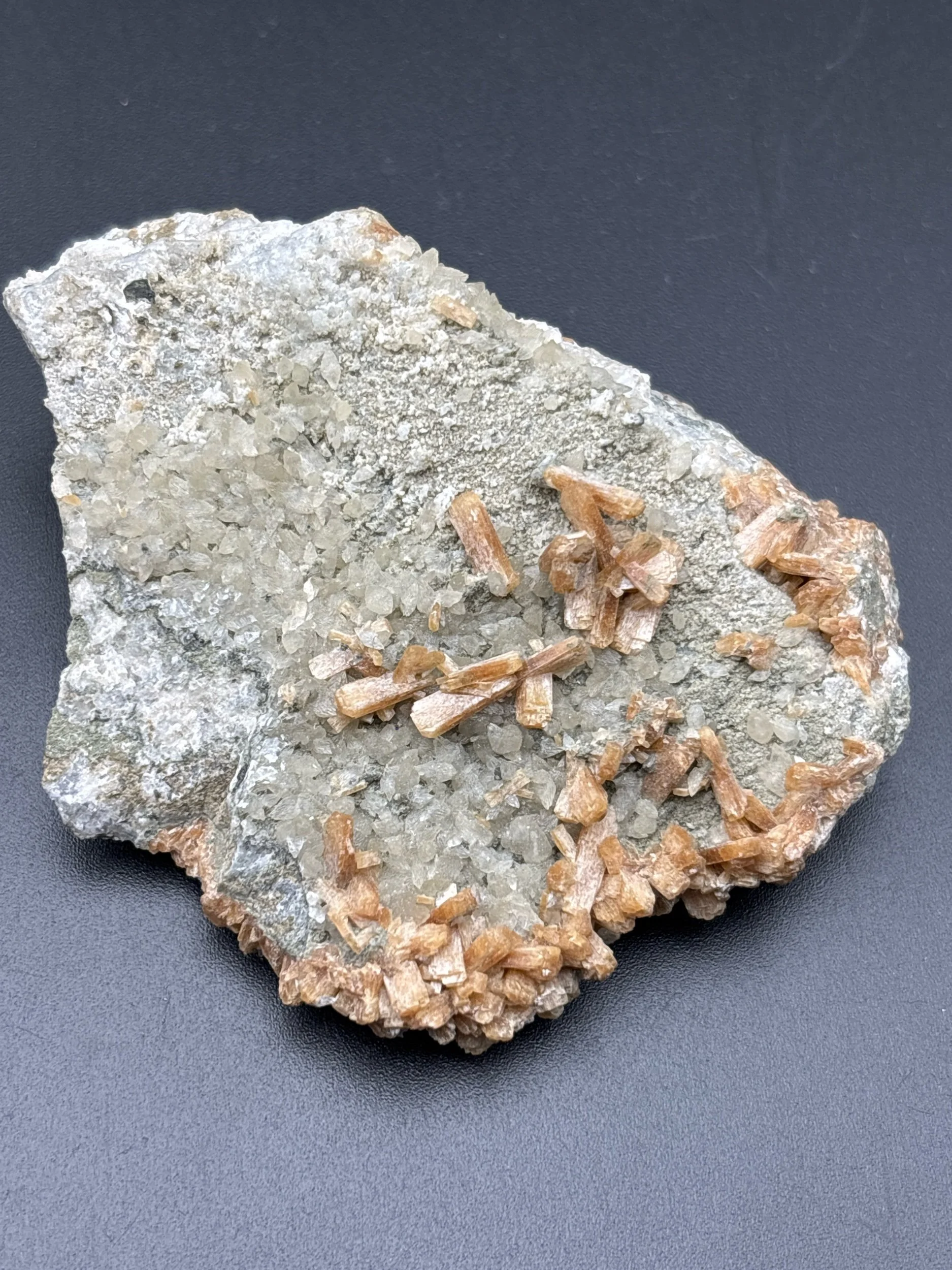
Featured here is a matrix coated primarily in stilbite but accented by nearly colorless calcites. Ex William Wall Collection, via Alexandria Mineral Shop. A USA classic from the northeast that seldom comes available! The provenance adds great bonus.
Thank you so much for viewing! Please message for any further information
(3.3 × 2.4 × 1.1 in - 8.4 × 6.3 × 2.8 cm) 4.1oz / 116g
Orders ship Mondays


Cooper & Stanley (1991):
"Of little commercial significance, this mine is one of the most famous mineral localities in the world. Lead minerals consisting predominantly of phosphate-bearing mimetite (campylite) in a gangue of quartz, barite and manganese oxides were deposited in an east-west vein. Other minerals occur rarely, the most well-known being plumbogummite.
Although mimetite specimens from Dry Gill are recorded from at least 1830 there is no record of commercial ore mining here until a lease was taken by Hugh Lee Pattinson, inventor of a cupellation process for the desilvering of lead. Pattinson began work in 1846, driving an adit on the vein where it crosses Dry Gill beck near the foot of the gill. He raised a few hundred tons of "colored lead ore" but gave up the work in the 1850's. The property was subsequently tried by various operators, none of whom had much success. The mine was last worked in 1869.
The finest mimetite specimens were collected in the 19th century but, although increasingly hard to find, some fine material has been obtained since, particularly in the 1970's. However, the mine is notoriously unstable, cold and wet, and there have been a number of accidents involving collectors. No one has been critically injured but the incidents have highlighted the dangers of the old workings in the Caldbeck Fells."
This specimen features a quartz matrix decorated in matte yellow barrel shaped mimetite crystals. From the collection of Barrie Bieler.
Thank you so much for viewing! Please message for any further information
(3.1 × 2.4 × 1.1 in - 8.0 × 6.1 × 2.9 cm) 4.3oz / 120g
Orders ship Mondays


The Kelly Mine, located in the Magdalena Mining District of Socorro County, New Mexico, emerged in the late 19th century as a major producer of lead, zinc, silver, and other metals, driving the rapid growth of the boomtown of Kelly. Mining began in the late 1870s, and expansion accelerated in the 1880s with improved rail connections that linked the district to regional and national markets. By the early 20th century, large companies such as the Empire Zinc Company consolidated operations, with zinc and lead becoming the mine’s primary products. As ore bodies were depleted and metal prices fluctuated, mining activity declined during the 1920s and 1930s. By the mid-1940s the town was largely abandoned, leaving behind prominent mine structures and ruins that today mark Kelly as a notable New Mexico ghost town and historic mining site. Final commercial mining ceased in 1957. The site is still mined for mineral specimens privately.
This example of smithsonite from the Kelly Mine is a much lesser seen brown, which is actually a classic color for older Kelly material! With a label detailing provenance to 1967, this specimen could also be from the 3 level the field collector label notes, but is denoted as 5 level. Lustrous spherules of smithsonite fill a vug in limonitic matrix. Overall, this is an amazing addition to any collector of antique, USA, or old mine locales!
Thank you so much for viewing! Please message for any further information
(3.4 × 2.4 × 1.6 in - 8.6 × 6.0 × 4.0 cm) 5.2oz / 147g
Orders ship Mondays


For over a century the Herja Mine has been operated for antimony, lead, and zinc commodities. It has produced some of the world’s finest crystalline stibnite examples and is type locality to the mineral fizelyite.
This specimen is a unique genesis of galena perimorphing pyrite, which pseudomorphed pyrrhotite. accents of late-stage dolomite and sphalerite are also present. Close examination of matrix edge reveals the story of genesis. This old time specimen displays wonderfully, and meets the criteria for many collection type.
Accompanied by the detailed label of Jimmie Duffoe, and the collection label of Charles M. Noll.
Thank you so much for viewing! Please message for any further information
(3.5 × 2.5 × 1.25 in - 8.9 × 6.3 × 3.2 cm) 10.6oz / 301g
Orders ship Mondays


The Little Giant Mine is a historic lead zinc and copper producer. All commercial production dates prior to 1904, with specimen collecting continuing the decades after closure. Most specimens come from the #3 tunnel, formally known as the Upper Giant Prospect. Hosted in St. Regis quartzite, the mine is located approximately 1.6 miles southeast of Mullan.
This is a classic example of pale, green, elongated pyromorphite crystals on matrix. Crystallization is present on two naturally displaying faces of the specimen. A must have for the collector of Idaho, lead minerals, PNW locales, US Classics, or antique specimens!
Thank you so much for viewing! Please message for any further information
(3.75 × 1.5 × 2.25 in - 9.5 × 3.8 × 5.7 cm) 7.7oz / 218g
Orders ship Mondays


The alpine clefts of Großer Ringkogel in Austria are famous for the hematite and quartz specimens they produce. Hosted in the lower Tauern Mountain Range, the area is host to almost 350 known species of minerals across its numerous sublocations.
This specimen is a beautiful example of specular hematite “roses” free formed on matrix. Natural display aesthetics are of great quality. Accompanied by a beautiful handwritten and hand trimmed European label as well.
Thank you so much for viewing! Please message for any further information
(4.17 × 2.0 × 1.69 in - 10.5 × 5.1 × 4.2 cm) 5.8oz / 166g
Orders ship Mondays
No results match your search. Try removing a few filters.
